Guide
Bass string gauges: light, standard and heavy sets, tension and scale
What the numbers on a pack of bass strings mean, how light, standard and heavy sets differ in feel and tension, and how to pick a gauge for your bass, tuning and style.
Published
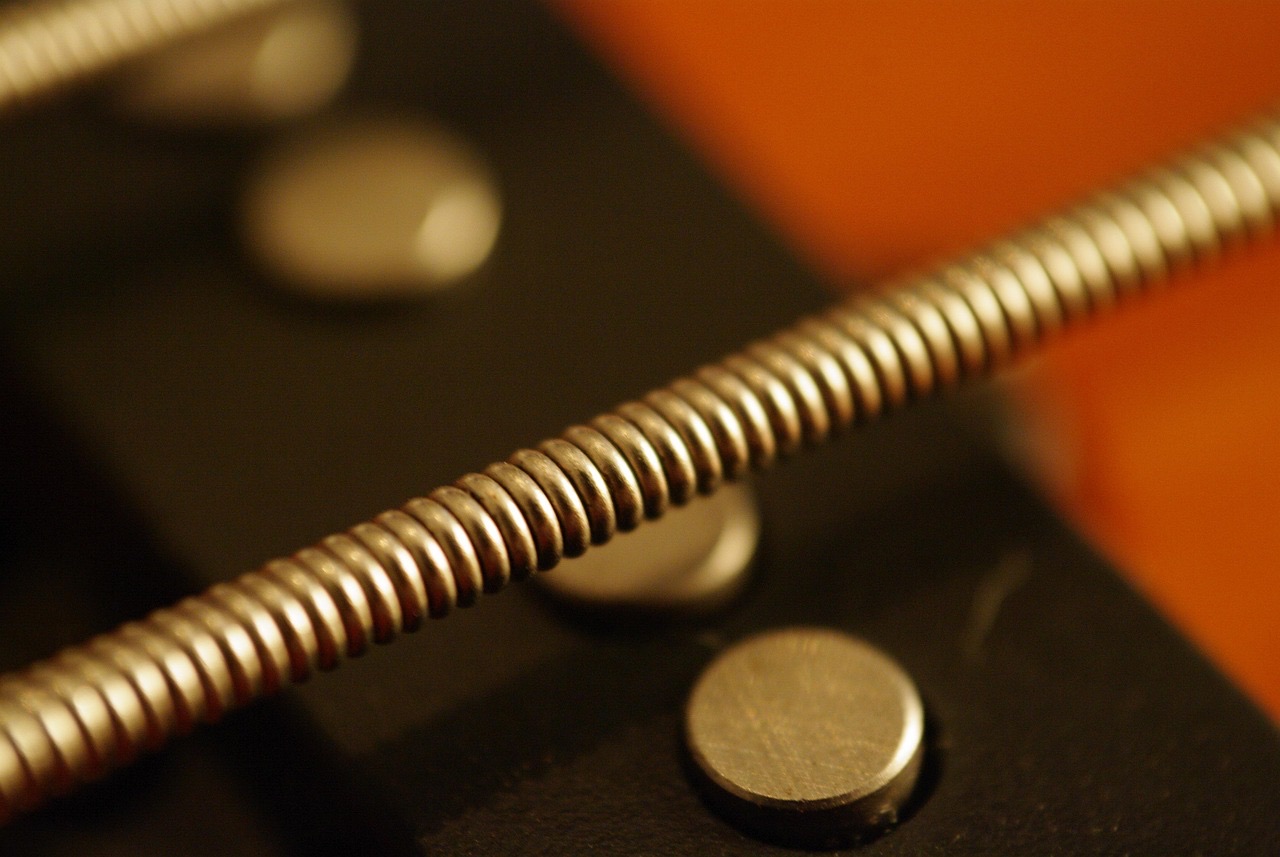
Bass string gauge is the thickness of each string, and it changes how a bass feels under your fingers, how much the strings pull on the neck and, to a degree, how it sounds. This guide explains how gauges are written, what light, standard and heavy sets look like for four-, five- and six-string basses, how gauge relates to tension and scale length, and how to choose. You should come away able to read any string pack and know whether a set will suit your bass.
How a bass string gauge is written
Gauge is the diameter of the string in thousandths of an inch. A .045 string is 0.045 inches thick. A set is named by its thinnest and thickest string, so a ".045–.105" four-string set has a .045 G string and a .105 low E, with the D and A strings in between. Makers often drop the decimal point, so "45–105" means the same thing.
The words on the pack are less reliable than the numbers. Rotosound sells its .045–.105 roundwounds as Standard and its .040–.095 set as Medium; Elixir labels its .045–.105 set Light/Medium, its .050–.105 set Medium and its .040–.095 set Super Light. Compare the gauges, not the names.
Standard, light and heavy four-string sets
Standard bass string gauge: .045–.105
The regular or standard bass string gauge for a four-string is .045–.105. Rotosound's stainless steel Swing Bass 66 Standard set is .045, .065, .080, .105, and its Jazz Bass 77 flatwounds come in the same outer gauges (.045, .065, .085, .105). La Bella's Deep Talkin' Bass flats are also offered in .045–.105. If you don't know what is on your bass, this is the usual factory gauge to start from.
Light gauge bass strings
Light sets usually start at .040 on the G. Rotosound's Swing Bass 66 set at .040, .060, .075, .095 is one example. Elixir notes that light gauges are generally favored for slap and pop playing, and that heavy sets need more finger strength than lighter ones; its own light set is .040–.095. La Bella's flats page also offers lighter options, .039–.096 and .043–.104.
Heavy gauge bass strings
Heavy sets start around .050. Rotosound's Swing Bass 66 Heavy set is .050, .070, .085, .110. Elixir says heavy-gauge strings, around .050–.105, have a richer bottom end but require more finger strength. La Bella's flats go up to .049–.109.
| Set | Example gauges (G, D, A, E) | Feel | Typical use |
|---|---|---|---|
| Light | .040, .060, .075, .095 | Easier to fret, more flexible | Slap and pop, light touch, smaller hands |
| Standard | .045, .065, .080, .105 | The reference most basses are set up for | Most styles; the safe default |
| Heavy | .050, .070, .085, .110 | Stiffer, needs a firmer touch | Big low end, lower tunings |
Example gauges are Rotosound's Swing Bass 66 sets.
String tension: what gauge really changes
Tension is the pull of a string tuned to pitch, and it is what you actually feel. Rotosound publishes a tension figure for each string. For its Swing Bass 66 roundwounds, the G string is listed at 39.50 lbs in the .040 set, 48.27 lbs in the .045 set and 53.21 lbs in the .050 set. Adding up Rotosound's figures for the four strings of each set, the light set comes to about 145 lbs, the standard to about 182 lbs and the heavy to about 197 lbs.

Same gauge, different tension
Gauge is only part of the story. Rotosound's support page warns that not all strings of the same gauge have the same core tension, that tension also varies between roundwound and flatwound strings, and that a change can call for a truss rod adjustment. Its own numbers show it: the .045 G string of the Jazz Bass 77 flatwound set is listed at 57.46 lbs, against 48.27 lbs for the .045 G of the Swing Bass 66 roundwounds. If a maker publishes a tension chart, compare tension, not just gauge. Our flatwound vs roundwound comparison covers the other differences.
Scale length and tension
Tension also depends on how long the vibrating part of the string is. For the same note and the same string, a longer scale needs more tension and a shorter scale less, which is why the same set feels slacker on a short-scale bass than on a 34-inch one. Makers' tension figures apply to the scale they were measured on, so treat them as a way to compare sets, not as the exact pull on your bass.
5-string bass gauge
A five-string set adds a low B string, usually around .125 to .135. Rotosound's Swing Bass 66 five-string standard set is .045, .065, .080, .105, .130, with the B listed at 32.56 lbs, the lowest tension in the set. Elixir suggests that five-string players can add a single B string in .125, .130 or .135 to one of its four-string sets.
A heavier B usually feels firmer under the fingers; a lighter one can feel loose, especially on a shorter scale. Our five-string bass guide covers the instrument itself.
Six-string bass gauges
A six-string bass usually adds a high C string above the G. Rotosound's Swing Bass 66 six-string standard set is .035, .045, .065, .080, .105, .130, and Elixir sells a .032 single C. La Bella's flatwound page lists six-string options that start with a .029 string.
Bass VI string gauge
A Bass VI is a different instrument from a six-string bass. Fender's Bass VI, introduced in 1961, has a 30-inch scale and six strings tuned E-A-D-G-B-E, an octave below a guitar, according to Wikipedia, which lists its standard gauges as .024, .034, .044, .065, .080, .100. La Bella says its Bass VI sets are made for Fender Bass VI instruments and are not six-string bass strings, which run from low B to high C. Buy strings sold specifically for the Bass VI.
Match the set to your scale length
Gauge is one number on the pack; length is the other. A set must be long enough to reach from the bridge to the tuning post. Rotosound's chart:
| Rotosound size | Fits scale lengths of | String length |
|---|---|---|
| Short | 30 in | 32.25 in |
| Medium | 30.5–32 in | 35.25 in |
| Long | 32–34 in | 37 in |
| Extra long | 33.5–36 in | 39.25 in |
Rotosound warns that "short", "medium" and "long" mean different things from one maker to another, so measure your bass: from where the ball end anchors to the nut, and from the ball end to the tuning post, then choose a string length between the two. Rotosound adds that string-through bridges add length without changing the scale. Our bass strings guide covers lengths and winding types in more detail.
How to choose a gauge
- Start from what is on your bass. If you don't know, assume .045–.105 on a four-string.
- Go lighter if your fretting hand tires quickly, you play a lot of slap and pop, or you want a slinkier feel. Elixir notes that light sets are generally favored for slap.
- Go heavier if you want a fuller low end, dig in hard, or tune down and the low strings feel loose. Elixir links heavier gauges to a richer bottom end.
- Change one step at a time, for example from .045–.105 to .040–.095 or .050–.105, and play the set for a while before judging.
After changing gauge
Elixir notes that jumping between gauges may require you to adjust the action and intonation of your bass, and a big change in tension can move the neck relief as well. Check the relief first, then string height and intonation, with small adjustments, as in our bass setup guide.
When to see a technician
If the neck needs more than a small truss rod turn, or a heavier set leaves the nut slots too tight for the strings to sit in, see the truss rod adjustment guide or take the bass to a technician.
Common mistakes
- Buying by label, not numbers. One maker's "medium" is another's "light".
- Ignoring length. The right gauge in the wrong length may not reach the tuning post, or may leave too much string at the post.
- Assuming the same gauge means the same feel. Flatwounds and roundwounds of the same gauge can differ a lot in tension.
- Skipping the setup. A new gauge on an old setup can buzz or play stiffly; change the strings, then check relief and action.
Questions
What is the standard bass string gauge?
For a four-string bass, .045–.105 is the usual standard set: .045 on the G string up to .105 on the low E. Rotosound sells its Standard sets in that gauge, and La Bella's Deep Talkin' Bass flats are offered in it too.
What gauge are light bass strings?
Light four-string sets usually run around .040 on the G to .095 on the E. Makers name them differently, so read the numbers rather than the label: Rotosound calls its .040–.095 set Medium, Elixir calls the same range Super Light.
What gauge are heavy bass strings?
Heavy four-string sets usually start around .050 on the G and run to .105 or .110 on the E. Rotosound's heavy roundwound set is .050–.110.
What gauge is the B string on a five-string bass?
Usually .125 to .135. Rotosound's standard five-string set uses a .130 B, and Elixir sells single B strings in .125, .130 and .135.
Do I need to adjust my bass after changing string gauge?
Often, yes. A different gauge changes the tension on the neck, so the relief, action and intonation may need small adjustments. Rotosound notes that even strings of the same gauge can differ in tension.
Sources
- Rotosound — Swing Bass 66 Medium 40-95 (RS66LC)
- Rotosound — Swing Bass 66 Standard 45-105 (RS66LD)
- Rotosound — Swing Bass 66 Heavy 50-110 (RS66LE)
- Rotosound — Swing Bass 66 5-String Standard 45-130 (RS665LD)
- Rotosound — Swing Bass 66 6-String Standard (RS666LD)
- Rotosound — Jazz Bass 77 Standard 45-105 (RS77LD)
- Rotosound — Bass string scale length guide
- Rotosound — Support: string tension and truss rod
- La Bella — Deep Talkin' Bass Flats 760FS
- La Bella — 767-6N Bass VI
- Elixir Strings — How to choose the best bass guitar strings
- Wikipedia — Fender Bass VI
Read next
Buying guide
Bass strings: windings, materials, gauges and how to choose a set
What the winding, the metal, the gauge and the length of a string do to the sound and feel of a bass, and how to read a string pack before you buy.
Guide
How to restring a bass: change your bass strings step by step
Remove the old set, thread each new string through the bridge, cut it to length, wind it neatly down the post and tune up, with the tools for each step.
Guide
Bass truss rod adjustment: direction, small turns and when to stop
Check the neck relief, find the adjustment nut, turn it a quarter at a time in the right direction, let the neck settle and recheck, and stop at the first sign of trouble.