Buying guide
5 string bass: what the low B adds and how to choose one
A fifth string extends the bass downward to a low B. Here is what that changes in the neck, the sound and your playing, and how to compare five-string basses.
Published
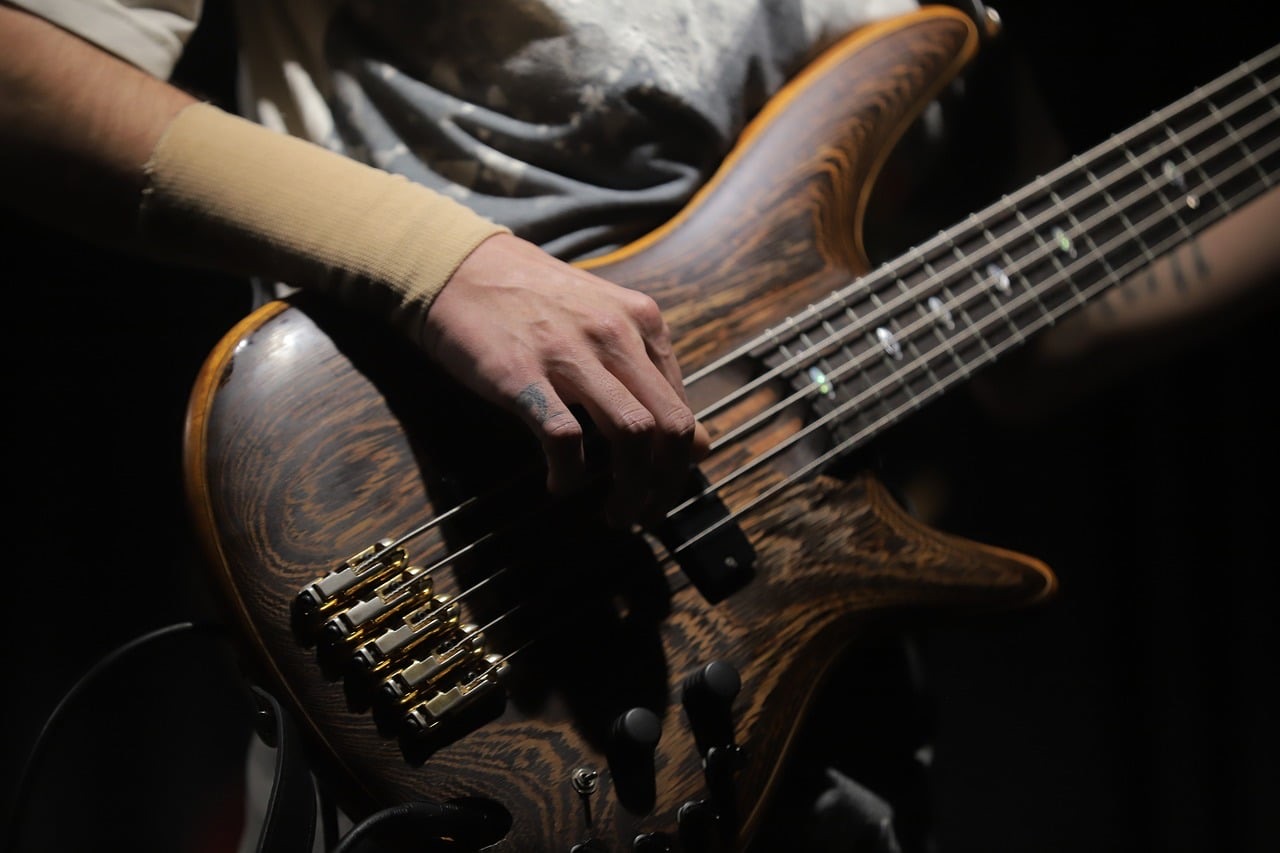
A 5 string bass adds one more string to the standard four, usually a low B below the E string. That extends the range downward, lets you play low notes without retuning, and changes the neck, the feel and the playing technique. This guide explains what a five-string bass does, how the types differ, what specs to compare (neck width, string spacing, scale length, pickups and electronics), which players it suits, and how to set one up.
What a five-string bass does
A standard four-string bass is tuned E A D G, low to high. A five-string bass most often adds a low B: B E A D G. The B sits a perfect fourth (five half steps) below the E, the same interval as between the other strings, so the patterns you know from four strings work the same on the new string.
What the low B gives you
- Lower notes. The five notes from B up to E♭ below the open E become available without detuning.
- More positions for the same note. Many notes on the E string can also be played on the B string higher up the neck, so you can stay in one position longer.
- Consistent tuning. If your music needs a low D or C, you can play it on the B string instead of retuning the E string between songs.
High C instead of low B
Some players add a high string instead, tuning E A D G C. This extends the range upward for chords and melodic playing rather than downward. It is less common, and most five-strings ship set up for a low B, so check which strings a bass comes with.

Types of 5 string bass
Five-string basses follow the same families as four-strings. The main difference between models is the body style and pickups they borrow.
| Type | Typical pickups | What to expect | Examples (from makers' pages) |
|---|---|---|---|
| Jazz Bass V style | Two single-coils | Wide tonal range, often active versions | Fender American Professional Jazz Bass V, Player II Modified Active Jazz Bass V; Squier Affinity Jazz Bass V, Classic Vibe '70s Jazz Bass V |
| Precision Bass V style | P pickup | One focused, punchy sound | Fender American Professional Precision Bass V |
| Modern style | Two dual-coil or humbucking pickups | Often active EQ and 24 frets | Ibanez SR305E |
Fender has offered five-string versions of its classic basses since the 1990s.
Fender five-string basses
Fender's current five-string Jazz Basses share key numbers. The American Professional Jazz Bass V, the Player II Modified Active Jazz Bass V and the Squier Affinity Series and Classic Vibe '70s Jazz Bass V all list a 34-inch scale and a 1.875-inch (47.6 mm) nut. The American Professional keeps passive volume, volume and tone controls with V-Mod III pickups; the Player II Modified is active, with a pan pot and three-band EQ. The Jazz Bass guide covers the design these are based on.
Ibanez five-string basses
Ibanez's SR series is a common example of the modern style. Ibanez lists the SR305E with:
- a 34-inch (864 mm) scale
- a 45 mm nut and 16.5 mm string spacing
- 24 medium frets
- two PowerSpan dual-coil pickups
- a volume, a pickup balance control, a three-band EQ and a three-way Power Tap switch
- a factory string set of .045–.130
What to look at in a five-string bass
Nut width and string spacing
This is the biggest change from a four-string. Compare Fender's four-string Player II Jazz Bass, with a 1.5-inch (38.1 mm) nut, to its five-string Jazz Basses at 1.875 inches (47.6 mm). Makers fit the extra string by widening the neck, narrowing the spacing between strings, or both.
- Wider spacing gives your plucking hand more room, which helps with slap and fast fingerstyle.
- Narrower spacing keeps the neck slimmer for your fretting hand.
Ibanez lists string spacing (16.5 mm on the SR305E); not every maker does, so measure or ask when you can. Try a five-string in person if possible: neck width affects comfort more than almost any other spec.
Scale length
Most five-strings use a 34-inch scale, the same as standard four-strings; every five-string mentioned here does. The low B string is thick and needs enough tension to sound clear rather than floppy. Some five-strings use a longer scale for that reason, so check the spec sheet if a tight B matters to you.
Pickups and electronics
Many five-strings are active: a battery-powered preamp boosts the signal and adds bass, middle and treble controls. That can help shape the low B, but means carrying spare batteries. Passive five-strings exist too, such as the American Professional Jazz Bass V. The basses section explains active and passive basses in general.
Weight and balance
A wider neck and an extra tuner add weight at the headstock. On a strap, check whether the bass hangs level or the neck dips toward the floor.
Strings
Five-string sets add a heavy low B; the SR305E's set runs .045 to .130. Check that replacement sets fit the bass, as low-B strings come in different gauges and lengths. See the bass strings guide.
Who a 5 string bass suits
Four strings or five
A five-string makes sense if
- the music you play regularly goes below E, for example parts written on keyboards or synths, or styles that use low tunings;
- you play covers in several keys and do not want to retune between songs;
- you read parts written for low notes, for example in theater or session work.
A four-string may suit you better if
- you are a complete beginner and most of your learning material uses four strings;
- you have small hands and find the wider neck a stretch;
- the music you play stays above E.
If you are not sure, start on a four-string such as a Precision Bass and add a five-string later. If budget is the deciding factor, Squier's Affinity Jazz Bass V is one lower-priced option; see the Squier basses guide.
Playing and setting up a five-string
Getting used to the extra string
- Mute more. The B string rings easily. Rest your plucking-hand thumb on the B string when playing higher strings, and use the fretting hand to damp strings you are not playing.
- Recalibrate your reference. It is easy to lose track of which string is which at first. Practice scales starting on the B string to make it a normal part of the neck.
- Watch your amp. Notes below E put more demand on a small practice amp or speaker; if it distorts, turn down or reduce the bass EQ. See the practice amp guide.
Setup
A five-string needs the same setup checks as any bass, with a little extra attention to the B string:
- Neck relief: adjust with small truss rod turns and recheck; a wide neck may take time to settle.
- String height: the B string vibrates widely, so it may need slightly more height to avoid buzz.
- Intonation: check each string at the 12th fret against the open string an octave lower.
If any of this is unfamiliar, have a technician set the bass up. Afterward, wipe the strings after playing and keep the bass away from rapid temperature and humidity changes.
What to check next
Read the Jazz Bass guide for the design behind most Fender five-strings, or the Squier basses guide for lower-priced options.
Questions
How is a 5 string bass tuned?
Standard tuning is B E A D G, low to high: a four-string bass's E A D G with a low B added below. Some players instead add a high C, tuning E A D G C.
Is a 5 string bass harder to play than a 4 string?
A little. The neck is wider (Fender's five-string Jazz Basses list a 1.875-inch nut against 1.5 inches on the four-string), and there is one more string to mute. With regular practice the extra string soon feels like a normal part of the neck.
Should a beginner start on a 5 string bass?
A four-string is the usual start, because the neck is narrower and most teaching material is written for it. If the music you want to play uses notes below E, starting on a five-string is reasonable.
What scale length does a 5 string bass have?
Most have the same 34-inch scale as a standard four-string; the Fender and Ibanez five-strings mentioned in this guide all list 34 inches. Some makers offer longer scales on five-strings, so check the spec sheet.
Does Fender make a 5 string Jazz Bass?
Yes. Fender sells Jazz Bass V models in the American Professional, American Ultra II and Player II Modified series, and Squier sells Affinity and Classic Vibe Jazz Bass V models.
Sources
- Ibanez — SR305E specifications
- Fender — American Professional Jazz Bass V specifications
- Fender — Player II Modified Active Jazz Bass V specifications
- Squier — Affinity Series Jazz Bass V specifications
- Squier — Classic Vibe '70s Jazz Bass V specifications
- Fender — Player II Jazz Bass specifications (four-string comparison)
- Fender — Precision Bass collection (American Professional Precision Bass V)
- Fender — Legendary lows: the Precision Bass story
Read next
Guide
Fender Jazz Bass: two pickups, a slim neck and a growling tone
Two single-coil pickups and a slim neck: what sets the J bass apart from the Precision, how to dial in its sound, and what changes on a five-string Jazz.
Buying guide in Strings & setup
Bass strings: windings, materials, gauges and how to choose a set
What the winding, the metal, the gauge and the length of a string do to the sound and feel of a bass, and how to read a string pack before you buy.
Guide
Fender Precision Bass: what a P bass is, how it sounds and who it suits
One pickup, two knobs and a 34-inch neck: why the P bass became the default electric bass, and how to choose between the versions sold today.