Guide
How to play bass: your first notes, hands and practice routine
Get the bass in tune, set up both hands, play your first notes in time and learn what to practice each day after that.
Published
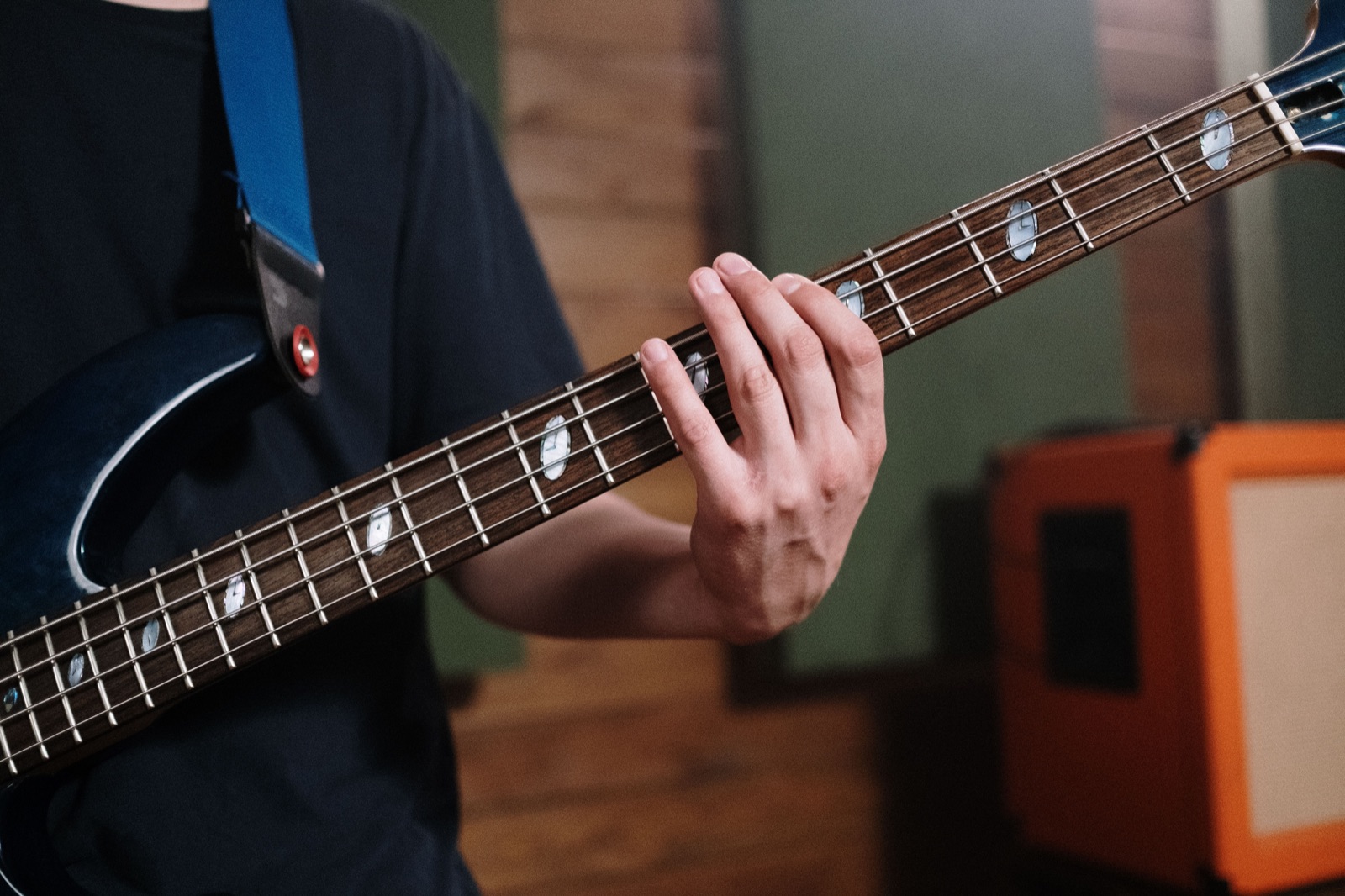
This guide shows you how to play bass from the very first session: get the instrument in tune, hold it comfortably, press and pluck the strings cleanly, and play simple root-note lines in time with a metronome. By the end you will have a short daily routine and a clear idea of what to learn next.
The bass guitar usually has four strings tuned E, A, D and G, one octave below the four lowest strings of a guitar. Most bass parts are single notes, so the job from day one is less about speed and more about playing each note cleanly and on the beat.
What you'll need
Essentials
-
Electric bass
: any four-string bass that stays in tune and has a comfortable string height is enough to start. -
Tuner
: a clip-on tuner or a tuner app gets every string to pitch before you play. -
Amp or headphone amp
: an unplugged electric bass is too quiet to hear what your hands are doing. -
Instrument cable and strap
: the cable connects the bass to the amp; the strap holds the bass at the same height sitting or standing.
Optional
-
Metronome or metronome app
: keeps a steady click so you can tell whether your notes land on the beat.
Step 1: tune the bass before every session
An out-of-tune bass makes correct notes sound wrong and trains your ear badly. Tune every time you pick the bass up: strings drift with temperature and handling. The four open strings, from the thickest to the thinnest, are E, A, D and G.
A clip-on tuner reads vibration through the headstock and shows the note name and whether you are sharp (too high) or flat (too low). The full method, including five-string basses and tuning by ear, is in how to tune a bass guitar.
Step 2: hold the bass
Sitting or standing, the bass should sit at roughly the same height, so set the strap so the body doesn't drop when you stand up. The neck points slightly upward rather than flat or down toward the floor. Neither hand should hold the weight of the instrument: the strap or your leg does that, which leaves both hands free to play.
Yamaha's tips for learning electric bass put comfort first: find a strap length that suits you and pay attention to how you sit and stand, because poor posture can lead to problems in the wrists, elbows, fingers, neck and back. If playing ever causes pain in your hands or wrists that doesn't go away with rest, see a doctor.
Step 3: set up the fretting hand
The fretting hand (the left hand for most right-handed players) presses the strings against the frets to choose the note.
Thumb and fingers
Bass Guitar For Dummies describes the basic position:
- Keep the wrist and hand loose rather than gripping the neck.
- Place the tip of your thumb on the middle of the back of the neck.
- Keep the fingers slightly curved, spread across four neighboring frets, with the fingertips close to the frets.
Press with the fingertip just behind the fret wire, not on top of it and not in the middle of the space. Close to the fret, you need less pressure for a clean note.
One finger per fret
Spreading your four fingers over four frets, one finger each, means you can reach most notes without moving your hand. Many bassists are taught this way, though Yamaha's fingering guide suggests deciding which fingerings work best for your hand and your bass's neck. On the lower frets of a 34-inch scale bass the frets are wide, so it's normal to stretch, or to shift the hand a fret, until your hand opens up.

Step 4: set up the plucking hand
The bass can be played with the fingers, the thumb or a pick. Fingerstyle is the most common starting point, so start there.
Anchor the thumb
Rest your thumb on a pickup or a thumb rest and let the weight of your arm settle onto it. The thumb works as a reference point: your hand pivots on it to reach the high and low strings.
Alternate index and middle fingers
Pluck with the index and middle fingers, alternating one after the other on each note, even when you stay on one string. Alternation keeps fast notes even. Pull the finger across the string toward the next one rather than lifting it high and slapping it down, which Dummies warns causes fret noise. After plucking, the finger usually comes to rest on the next thicker string, which also keeps that string quiet.

Step 5: play your first notes
Start with open strings. Set a metronome to 60 beats per minute and pluck the open E string once on each click, alternating index and middle fingers. Do four clicks on each string: E, A, D, G, then back down.
G|-------------------------------0---0---0---0--|
D|-----------------------0---0---0---0----------|
A|---------------0---0---0---0------------------|
E|---0---0---0---0------------------------------|
Then add fretted notes. On the E string, play fret 3 (the note G) four times, then fret 5 (A) four times. Keep the fretting finger pressed until the next note starts so the notes connect.
If tablature is new to you, each line is a string and each number is the fret to press; how to read bass tabs explains the rest.
Root and fifth
The first pattern almost every bassist learns is the root and fifth. The root is the note a chord is named after; the fifth is seven half steps (frets) above it. In standard tuning, the fifth sits on the next higher string, two frets up.
G|----------------|
D|----------------|
A|-----5-------5--|
E|-3-------3------|
Here the root is G (E string, fret 3) and the fifth is D (A string, fret 5). Move the same shape anywhere on the E and A strings and it still works: start on fret 5 for A and E, or on fret 3 of the A string for C and G.
Step 6: mute the strings you aren't playing
Bass strings ring loudly, and an open string you aren't playing will hum under the next note. Muting keeps the line clean:
- The plucking finger resting on the next string after a stroke mutes that string.
- The fretting hand's fingers can lightly touch strings you aren't playing.
- To stop a note, lift the fretting finger just enough to release the pressure while keeping it on the string.
Listen for buzzing or ringing between notes and fix it slowly, at a tempo where you can hear everything.
Common mistakes when learning how to play bass
- Pressing too hard. Use just enough pressure for a clean note, close to the fret. Too much tires the hand quickly.
- Skipping the metronome. Bass and drums keep time for the band, so timing matters more than speed. Practice with a click from the first week.
- Plucking with one finger only. It feels easier at first but limits speed and evenness later.
- Letting open strings ring. Muting is part of the technique, not an extra.
- Long sessions with sore fingertips. Calluses take time to build; short daily sessions are better than one long one.
The best way to learn bass: a short daily routine
The most reliable way to learn bass is regular, short practice with a plan. A starting routine of about 20 to 30 minutes could look like this:
A 20- to 30-minute session
Warm-up, 5 minutes
Open strings with alternating fingers, then one-finger-per-fret on each string (frets 1-2-3-4 and back) at a slow metronome setting.
Technique, 10 minutes
Root-and-fifth patterns, then the notes of one scale. Raise the tempo only when every note is clean.
Songs, 10 to 15 minutes
Play along with recordings you like. Yamaha's tips call this the time-honored route to getting started on bass: it teaches you where the notes are and lets you hear details you might otherwise miss.
Yamaha also suggests getting your bass properly set up, so the strings are not too high to press down, and finding people to play with once you can hold a simple line. If the strings feel very hard to press, see the bass setup guide.
What to learn next
Once the open strings and root-fifth patterns feel easy:
- Learn the note names on the E and A strings with the bass fretboard notes guide.
- Play the major scale and minor pentatonic from bass scales for beginners.
- Turn root and fifth into full chord shapes with bass chords and arpeggios.
If you don't have a bass or an amp yet, the guides to a first bass and a practice amp explain what to look for.
Questions
Can I learn to play bass on my own?
Yes. Many players start alone with tablature, a tuner and a metronome. A teacher helps by spotting habits you can't see yourself, such as a tense wrist or uneven plucking, so a few lessons early on are worth considering.
How long does it take to learn bass?
With short daily practice, most beginners play simple root-note parts within a few weeks. Steady timing, clean muting and knowing the fretboard take months, and players keep improving for years.
Is bass easier to learn than guitar?
The first steps are often quicker because bass parts are mostly single notes rather than chords. The bass has its own demands, though: heavier strings, wider fret spacing and the job of keeping time with the drummer.
What is the best way to learn bass?
Combine three things: correct hand technique from the start, playing with a metronome every session, and playing along with recordings you like. Short daily practice works better than one long session a week.
Should I learn bass with fingers or a pick?
Both are correct. Fingers are the usual starting point and give a rounder tone; a pick gives a sharper attack common in rock and punk. Many players learn fingerstyle first and add the pick later.
Sources
- Wikipedia — Bass guitar
- Dummies — How to position your left hand on a bass guitar
- Dummies — How to position your right hand on a bass guitar for finger-style playing
- Dummies — How to warm up on the bass guitar with right-hand same-string strokes
- Yamaha Hub — Tips for the beginning bassist
- Yamaha Hub — Eight great tips for learning electric bass
- Yamaha Hub — Bass fingering 101
Read next
Guide
How to tune a bass guitar: standard, five-string and drop D
Standard E A D G with a tuner or by ear, the low B of a five-string, six-string tuning and drop D, with the checks that keep it in tune.
Buying guide in Basses
Beginner bass guitar: how to choose your first bass
The types of first bass, the few specifications that change how one feels in your hands, and how to match them to your body, your music and your budget.
Buying guide in Amps & effects
Bass practice amp: small combos, headphone amps and how much power home playing needs
A small combo, a headphone amp or a modeling amp: what each does at home, how much power quiet practice needs, and the jacks that matter.