Guide
How to read bass tabs: strings, frets, symbols and rhythm
Which line is which string, what the numbers and symbols mean, and how to get the rhythm that tablature leaves out.
Published
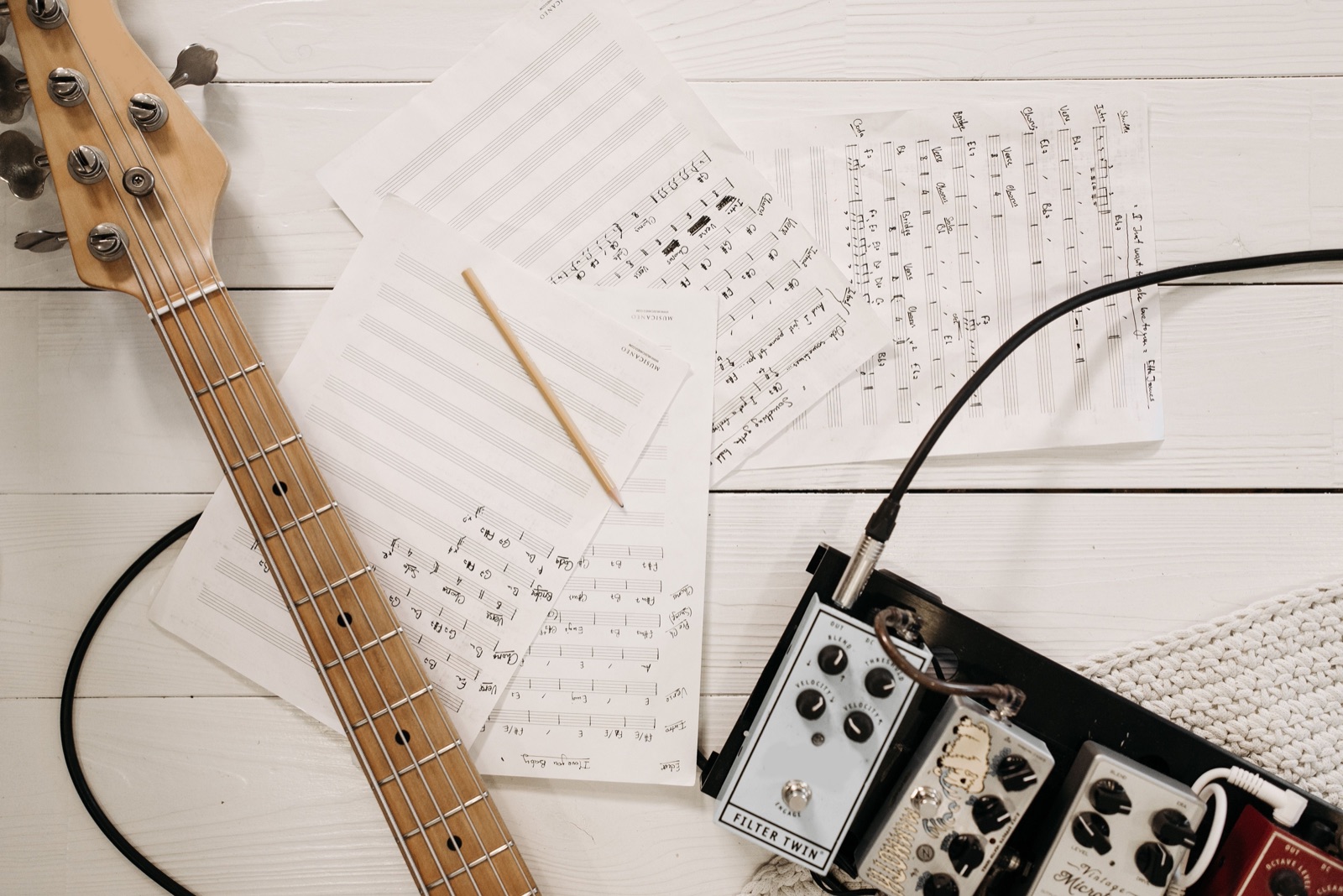
Bass tabs show you where to put your fingers: which string to play and which fret to press. You don't need to read music to use them, which is why most beginners start here. This guide explains how to read bass tablature line by line, what each symbol means, and how to get the rhythm that plain tabs leave out. The examples are short exercises written for this page.
Before you start, tune your bass to standard tuning, E A D G from the thickest string to the thinnest, with how to tune a bass guitar. Tabs assume standard tuning unless they say otherwise at the top.
What bass tabs are
Tablature is a kind of notation that shows where to place your fingers rather than the pitch of each note. It was common for the lute in the Renaissance and Baroque eras and is still widely used today, often printed alongside standard notation. Standard notation tells you pitch and rhythm; tablature tells you the position on the instrument and leaves the pitch implied.
That makes bass tablature for beginners an easy first step: you can play a line the day you get the bass. Its weakness is rhythm, which comes later in this guide.

How to read a bass tab: lines are strings
A four-string bass tab has four horizontal lines, one for each string. The usual layout puts the highest string on top and the lowest at the bottom:
G|--------|   thinnest string, highest pitch
D|--------|
A|--------|
E|--------|   thickest string, lowest pitch
Think of it as looking down at the strings while you hold the bass: the E string, closest to your face, is at the bottom of the tab. The letters at the left tell you which string is which. Layouts aren't fully standardized, so a well-written tab labels its lines, and you should always check them.
Five-string bass tabs
A five-string bass in standard tuning adds a low B below the E, so its tab has five lines: G, D, A, E and B, with B at the bottom.
G|--------|
D|--------|
A|--------|
E|--------|
B|--------|
Numbers are frets
A number on a line tells you which fret to press on that string. A 0 means the open string, played without pressing any fret.
G|-----------------|
D|-----------------|
A|-----------------|
E|--0--3--5--------|
Read this as: play the open E string, then the E string at fret 3, then at fret 5. Those notes are E, G and A.
Tabs are read left to right, like text. Numbers that appear one after another are played one after another. Numbers stacked in the same column are played together:
G|---------|
D|--5------|
A|--5------|
E|--3------|
This stack is G (E string, fret 3), D (A string, fret 5) and G (D string, fret 5): root, fifth and octave played at once. On bass, stacked notes are less common than on guitar, and when they appear they are usually two or three notes like these.
Which finger to use
Tabs don't say which finger presses each fret. A good default is one finger per fret: for the notes at frets 3 and 5 in the first example, put your first finger at fret 2, so fret 3 falls under your second finger and fret 5 under your fourth. Yamaha's fingering guide points out that almost every note on the bass can be played in two or three places, so a tab is one choice among several. If a stretch feels impossible, look for the same note on another string.
Bass tab symbols
Tab symbols aren't standardized; publishers and websites vary, and a good tab includes a legend. These are the most common:
| Symbol | Meaning | Example |
|---|---|---|
h |
hammer-on: pluck the first note, then press the second fret without plucking again | 5h7 |
p |
pull-off: pluck the higher note, then pull the finger off to sound the lower note | 7p5 |
/ |
slide up to the next note, keeping the finger pressed | 5/7 |
\ |
slide down | 7\5 |
x |
muted, percussive note: touch the string without pressing it to the fret | x |
~ or v |
vibrato: shake the fretted note slightly | 7~ |
b |
bend the string up in pitch | 7b |
* or <12> |
natural harmonic: touch the string lightly over the fret | <12> |
Symbols in context
A practice line with symbols
This short exercise uses a slide, a hammer-on and a pull-off on the A and D strings:
G|-------------------------|
D|--------------5h7p5------|
A|--3/5---5----------------|
E|-------------------------|
Pluck the A string at fret 3 and slide up to fret 5, pluck fret 5 again, then on the D string pluck fret 5, hammer onto fret 7 and pull off back to fret 5.
Rhythm: what bass tabs don't tell you
Here is the big limitation. A plain text tab shows which notes to play and in what order, but not how long each note lasts or where the rests are. Yamaha's guide to reading for bass puts it plainly: tab lacks information about rests, rhythm, note length and expression.
Some tabs add a little help:
- Spacing. Some writers space the numbers to suggest timing, with more dashes for longer notes. It's a rough guide at best.
- Rhythm letters. Some tabs place letters above the lines for note lengths, such as W (whole), H (half), Q (quarter) and E (eighth).
- Bar lines. A
|across all four lines marks the end of a bar (measure), which at least tells you how many notes fall in each one. - Tab with notation. Published bass books often print standard notation above the tab: the tab shows where to play, the notation shows the rhythm.
Counting the beats
Counting a bar
This basic bass tab is one bar of 4/4 time with one note on each beat. Count "1, 2, 3, 4" out loud with a metronome and play a note on each number:
     1   2   3   4
G|-----------------|
D|-----------------|
A|-----------3---5-|
E|---3---5---------|
G, A, C, D: one note per beat. When you learn a song, listen to the recording first and match the tab's notes to what you hear. The tab gives you the notes; the recording gives you the rhythm.
Easy bass tabs to practice reading
These easy bass tabs are exercises, not songs. Play each one slowly with a metronome, one note per click.
Exercise 1: open strings and fret 3
G|-------------------0---3--|
D|-----------0---3----------|
A|---0---3------------------|
E|--------------------------|
Exercise 2: root and fifth
The root is the note a chord is named after; the fifth is seven frets above it, which in standard tuning sits on the next string up, two frets higher.
G|-------------------------------|
D|-------------------------------|
A|-----5-------5-------7-------7-|
E|-3-------3-------5-------5-----|
This is G and D, then A and E.
Exercise 3: root, fifth and octave
The octave is the same note twelve frets higher; on bass it is also two strings up and two frets up.
G|-------------------------------|
D|-----------5---------------7---|
A|-------5---------------7-------|
E|---3---------------5-----------|
G, D, G, then A, E, A.
Common mistakes reading bass tabs
- Reading the lines upside down. If a line sounds far too high or low, check whether the tab puts the E string on top.
- Ignoring the tuning note. Tabs for drop D or a five-string say so at the top. Played in the wrong tuning, every note on the low string comes out wrong.
- Treating a tab as the only right way. Tabs found online are often transcribed by ear and can be wrong. Trust the recording.
- Skipping rhythm. Getting the notes right but the timing wrong still sounds wrong in a band.
What to learn next
Once you can read tabs comfortably, learn what the numbers actually are. Bass guitar notes on the fretboard turns fret numbers into note names, which lets you read chord charts and talk to other musicians. To go back to the basics of holding the bass and plucking, see how to play bass.
Questions
What are bass tabs?
Bass tabs, short for tablature, are a way of writing bass parts that shows which string to play and which fret to press, instead of the note's pitch on a staff. Each horizontal line stands for a string and each number for a fret.
Which line is the E string in bass tab?
In most bass tabs the bottom line is the low E string and the top line is the G string, so the tab looks like the strings seen from above when you hold the bass. Check the letters at the start of each line, because not every tab follows this order.
What does 0 mean in bass tabs?
A 0 means you play the open string, without pressing any fret.
Do bass tabs show rhythm?
Plain text tabs usually don't show how long each note lasts or where the rests are. Use the recording to get the rhythm, or use tabs that add rhythm marks or come with standard notation.
Are bass tabs good for beginners?
Yes. Tablature is the quickest way for a beginner to start playing real bass lines because it needs no music reading. Learning the note names on the fretboard and some rhythm reading alongside it helps you go further.
Sources
Read next
Guide
How to play bass: your first notes, hands and practice routine
Get the bass in tune, set up both hands, play your first notes in time and learn what to practice each day after that.
Guide
Bass guitar notes: every note on the fretboard and how to learn them
A chart of every note on the four strings up to fret 12, the patterns that make the fretboard easier to map, and exercises to learn it string by string.
Guide
How to tune a bass guitar: standard, five-string and drop D
Standard E A D G with a tuner or by ear, the low B of a five-string, six-string tuning and drop D, with the checks that keep it in tune.