Guide
Bass guitar chords and arpeggios: chord tones, shapes and a chart
Which notes make up each chord, how to play them as arpeggios on a four-string bass, the two-note chords that sound good low down, and a chart to keep.
Published
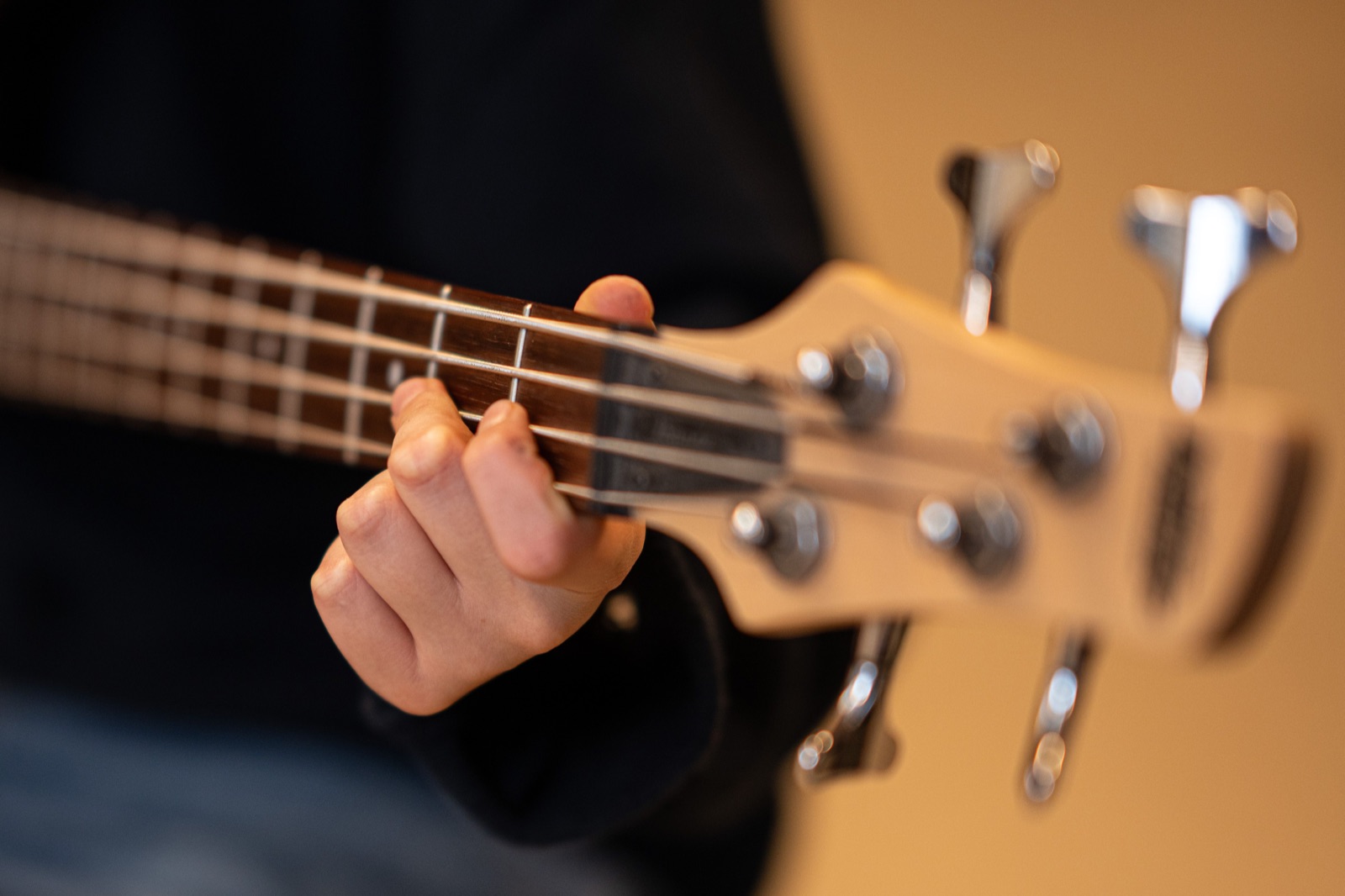
Bass guitar chords work differently from guitar chords. A bassist rarely strums three or four notes at once; instead you play the notes of the chord one after another, as an arpeggio, or pick two notes that sound clear in the low register. This guide shows you which notes make up the common chords, movable arpeggio shapes for a four-string bass in standard tuning, the two-note chords bassists actually use, and a bass guitar chord chart to keep beside you.
You'll find it easier if you know the note names on the E and A strings; see bass guitar notes on the fretboard if not.
How bass guitar chords work
A chord is three or more notes sounded together. The basic chord is the triad: a root, a third and a fifth, built by stacking thirds.
- Root: the note the chord is named after. G is the root of G major.
- Third: three or four half steps above the root. Four half steps (a major third) makes the chord major; three (a minor third) makes it minor.
- Fifth: seven half steps above the root, a perfect fifth, in both major and minor chords.
Seventh chords add a fourth note on top: the seventh, ten or eleven half steps above the root.
In a band, the guitar or keyboard usually plays the full chord and the bass plays its foundation: the root on the strong beats, with the third, fifth and seventh as connecting notes. That's why arpeggios matter more to a bassist than chord shapes.
Arpeggios: chords one note at a time
An arpeggio is a chord whose notes are played one after another, rising or falling, instead of all at once. Every shape below starts with the root on the E string and is movable: slide it to another fret and the chord changes name, not type.
The bass G chord: G major arpeggio
A G major chord is G, B, D. Starting on the E string at fret 3:
G|------------------|
D|-------------5----|   G (octave)
A|-----2---5--------|   B (3rd), D (5th)
E|-3----------------|   G (root)
Fingers: 2 on the root, 1 on the third, 4 on the fifth and 4 (or 3) on the octave. This is the same note set as the first, third and fifth notes of the G major scale.
Minor arpeggio
A G minor chord is G, B♭, D. The only change is the third, one fret lower. The easiest fingering puts the minor third on the E string:
G|------------------|
D|-------------5----|   G (octave)
A|---------5--------|   D (5th)
E|-3---6------------|   G (root), B♭ (♭3rd)
Fingers: 1 on fret 3, 4 on fret 6, 3 on the A and D strings at fret 5.
Seventh arpeggios
Add the seventh on the D string, in place of the octave:
G7 (G B D F)        Gmaj7 (G B D F♯)     Gm7 (G B♭ D F)
G|------------|     G|------------|      G|------------|
D|---------3--|     D|---------4--|      D|---------3--|
A|-----2-5----|     A|-----2-5----|      A|-------5----|
E|-3----------|     E|-3----------|      E|-3-6--------|
- Dominant seventh (G7): major triad plus a minor seventh, ten half steps above the root. Common in blues and rock.
- Major seventh (Gmaj7): major triad plus a major seventh, eleven half steps up, one fret below the octave.
- Minor seventh (Gm7): minor triad plus a minor seventh.
Moving the shapes
Start the same shapes on another fret of the E string: fret 5 gives A, fret 8 gives C, fret 1 gives F. To play chords from the A string, use the same shapes one string higher. C major from the A string at fret 3:
G|----------------|
D|-------2---5----|   E (3rd), G (5th)
A|---3------------|   C (root)
E|----------------|
Add the G string at fret 5 for the octave C. Yamaha's fingering guide points out that almost every note on the bass can be played in two or three places, so each chord has more than one shape; these are the most compact starting points.

Bass chords on 4 strings: two-note shapes
Arrangers use guidelines called low interval limits: below a certain pitch, notes played close together stop sounding clear and turn muddy, and wide, consonant intervals such as the fifth hold up lower than close, dissonant ones such as the minor second. Most of the bass range sits in that low register, so three or four notes played together on the low strings usually blur. Bassists who play chords mostly use two-note shapes (often called double stops) with wider spacing.
Root and fifth
G|--------|
D|--------|
A|---5----|   D
E|---3----|   G
The root on the E string and the fifth on the A string, two frets up. It has no third, so it fits both major and minor chords. Guitarists call this a power chord.
Root and octave
G|--------|
D|---5----|   G
A|--------|
E|---3----|   G
The same note twelve half steps apart: two strings up, two frets up. Mute the A string with the underside of your fretting finger.
Root and tenth
G|---4----|   B
D|--------|
A|--------|
E|---3----|   G
A tenth is a third plus an octave. Spreading the third an octave higher keeps a major or minor sound without the mud. For a minor tenth, play the G string one fret lower (fret 3, B♭).
Muting the middle strings
The A and D strings sit between the two notes of a tenth. Rest the fretting hand lightly across them so only the outer two strings sound when you pluck.
Bass guitar chord chart
Use this chart to work out the notes of any common chord. The half-steps column counts the half steps (frets) from the root to each note.
| Chord | Symbol | Formula | Half steps | In G | In C |
|---|---|---|---|---|---|
| Major | G | 1 3 5 | 0 4 7 | G B D | C E G |
| Minor | Gm | 1 ♭3 5 | 0 3 7 | G B♭ D | C E♭ G |
| Diminished | Gdim | 1 ♭3 ♭5 | 0 3 6 | G B♭ D♭ | C E♭ G♭ |
| Augmented | Gaug | 1 3 ♯5 | 0 4 8 | G B D♯ | C E G♯ |
| Major seventh | Gmaj7 | 1 3 5 7 | 0 4 7 11 | G B D F♯ | C E G B |
| Dominant seventh | G7 | 1 3 5 ♭7 | 0 4 7 10 | G B D F | C E G B♭ |
| Minor seventh | Gm7 | 1 ♭3 5 ♭7 | 0 3 7 10 | G B♭ D F | C E♭ G B♭ |
| Half-diminished | Gm7♭5 | 1 ♭3 ♭5 ♭7 | 0 3 6 10 | G B♭ D♭ F | C E♭ G♭ B♭ |
Reading a bass chord sheet
A chord sheet (or chord chart) shows chord symbols above the lyrics or in bars, without a written bass part. Your job is to turn the symbols into a line:
- Play the root on the first beat of each new chord. That alone gives you a usable part.
- Add the fifth to fill the bar: root on beats 1 and 3, fifth on beats 2 and 4, for example.
- Use the third and seventh from the chart to connect chords once the roots feel solid.
- Slash chords such as G/B name the bass note after the slash: play B, not G.
Easy bass chords: a G, C, D progression
G, C and D are the three main chords in the key of G, and they're among the easiest bass chords to start with because all three roots sit near frets 3 to 5. Here is one bar of each, root and fifth, one note per beat:
     G               C               D
G|---------------|---------------|---------------|
D|---------------|-----5-------5-|-----7-------7-|
A|-----5-------5-|-3-------3-----|-5-------5-----|
E|-3-------3-----|---------------|---------------|
G: root G (E3), fifth D (A5). C: root C (A3), fifth G (D5). D: root D (A5), fifth A (D7). Play it with a metronome, then try the major arpeggios over the same chords.

Common mistakes
- Playing full guitar-style chords on the low strings. They usually sound muddy; use arpeggios or two-note shapes.
- Playing the third when the guitar plays a power chord. If the guitar part has no third, a major or minor third from the bass decides the chord for everyone. Stick to roots and fifths until you know the harmony.
- Forgetting to mute. Two-note shapes leave strings between them that can ring. Mute them with the fretting hand.
- Learning shapes without note names. Say "root, third, fifth" or "G, B, D" while you play.
What to learn next
Arpeggios come out of scales: the major arpeggio is the first, third and fifth notes of the major scale. Learn the scales they come from in bass scales, and if you need to refresh your basic technique, go back to how to play bass.
Questions
Can you play chords on a bass guitar?
Yes, but bass players mostly play chords one note at a time, as arpeggios, or as two-note shapes such as root and fifth or root and tenth. Three- and four-note chords on the low strings usually sound muddy, because close intervals blur in the low register.
What is a G chord on bass?
A G major chord is made of the notes G, B and D. On a four-string bass, play G on the E string at fret 3, B on the A string at fret 2, D on the A string at fret 5 and G again on the D string at fret 5.
What is an arpeggio on bass?
An arpeggio is a chord played one note at a time instead of all together. On bass it is the main way to outline a chord: root, third, fifth and often the octave or seventh.
What is the difference between a major and a minor chord?
Only the third. A major chord has a major third, four half steps above the root; a minor chord has a minor third, three half steps above the root. The root and fifth are the same.
What does a slash chord like G/B mean for the bass player?
The letter after the slash is the bass note. For G/B the band plays a G chord and the bass plays B instead of the root G.
Sources
Read next
Guide
Bass scales for beginners: major, minor, pentatonic and blues
The five scales to learn first, with one movable fingering for each, tab in G and A, and a chart of their notes.
Guide
Bass guitar notes: every note on the fretboard and how to learn them
A chart of every note on the four strings up to fret 12, the patterns that make the fretboard easier to map, and exercises to learn it string by string.
Guide
How to play bass: your first notes, hands and practice routine
Get the bass in tune, set up both hands, play your first notes in time and learn what to practice each day after that.