Buying guide
Bass practice amp: small combos, headphone amps and how much power home playing needs
A small combo, a headphone amp or a modeling amp: what each does at home, how much power quiet practice needs, and the jacks that matter.
Published
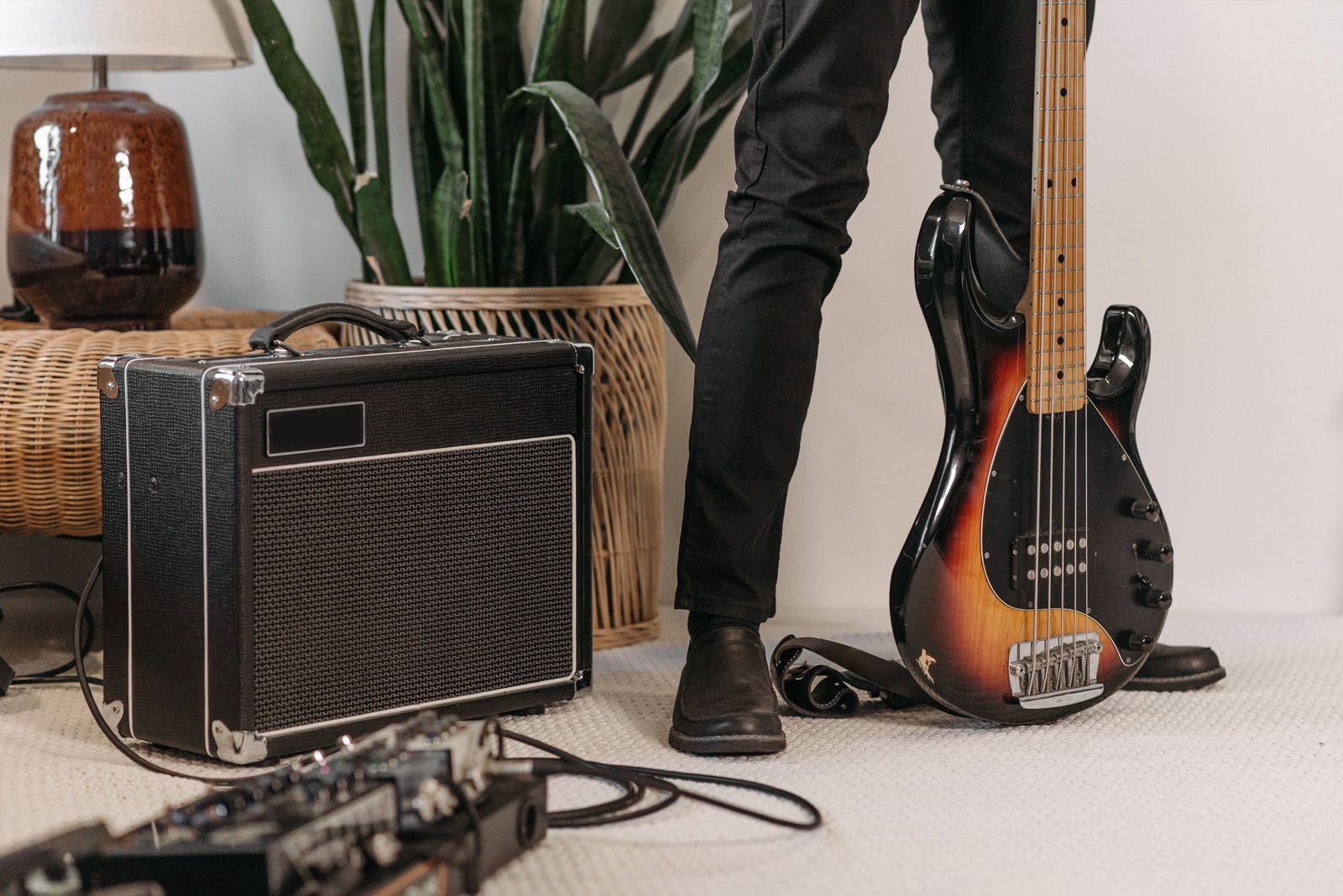
A bass practice amp has one job: let you hear your bass clearly at home, at a volume that suits the room and the people around you. That can be a small combo with an 8- or 10-inch speaker, a headphone amp the size of a matchbox, or a modeling amp with built-in effects. This guide explains what each type does, how much power you actually need for home playing, and which inputs and outputs make daily practice easier.
What a bass practice amp does
Every bass amp has the same three parts: a preamp that shapes the tone, a power amp that drives the speaker, and a speaker in a cabinet. Yamaha's guide to bass amps describes a combo as all three in one box. A practice amp is simply a small combo built for low and moderate volume, usually with a headphone output so you can turn the speaker off entirely.
Bass needs its own amp because low notes demand more from a speaker. Yamaha notes that bigger speakers give more low end while smaller ones give more detail, and that bass amps generally weigh more than guitar or keyboard amps. At practice volume a small speaker is enough; it is when you need to keep up with a drummer that size and power start to matter.
Types of small bass amp
There are four common ways to hear yourself at home. The table compares them, using makers' own specifications as examples of each type.
| Type | Example (maker's spec) | Speaker | Power | Best for |
|---|---|---|---|---|
| Headphone amp | Vox amPlug 2 Bass | none, headphones only | two AAA batteries | silent practice, travel |
| Small combo | Ampeg Rocket Bass RB-108 | one 8-inch | 30 watts | home practice, a beginner's first amp |
| Mid-size combo | Ampeg Rocket Bass RB-110 | one 10-inch | 50 watts | home, small jams at low volume |
| Modeling combo | BOSS Katana-110 Bass | one 10-inch plus tweeter | 60 watts RMS | home practice with built-in effects |
Headphone amps (mini bass amps)
A headphone amp plugs straight into the output jack of your bass. You plug headphones into it and hear an amp-like tone with no speaker at all. Vox's page for the amPlug 2 lists the bass version as designed for low frequencies, with an aux input and a headphone jack, running on two AAA batteries for about 11 hours with its effects and rhythm function on, or about 17 hours with them off. It is about as portable as a bass amp gets, and it lets you practice late at night without a sound in the room.
The limits: no one else can hear you, and you can't plug in a second instrument or a band.
Small combos (8- and 10-inch)
A small combo is the classic bass practice amplifier. Ampeg describes its 30-watt Rocket Bass RB-108, with one 8-inch speaker, as a practice amp; it weighs 23 lbs and has two inputs (0 dB and -15 dB), a three-band EQ, an aux input and a headphone output. The next model up, the RB-110, has a 10-inch speaker and 50 watts.
A combo lets you hear the bass in the room, which is closer to how it sounds with other players, and it is easy to set up: plug in, set the EQ flat, play.
Modeling combos
Modeling amps add digital amp voices and effects. The BOSS Katana-110 Bass is rated at 60 watts continuous (RMS), with one 10-inch woofer and a tweeter. Its spec sheet lists an aux input, a combined recording and headphone jack, a USB port and an effects loop. That is a lot more than a beginner strictly needs, but it means one box covers practice, effects and recording into a computer. The trade-off is weight: BOSS lists it at 37 lbs.
How many watts for home practice
For playing alone at home, a small combo of about 30 to 60 watts, such as the RB-108 or the Katana-110 Bass, is usually enough. It fills a bedroom or living room, where you will usually play well below full volume.
Power matters more as soon as a drummer joins. Yamaha's guide puts it plainly: for most rehearsals and gigs a 50-watt amp is underpowered, while about 300 watts gets the job done. So if you expect to play with a band within a year, consider a bass combo amp with more power instead of a practice amp you will soon outgrow.
Keep the volume sensible on headphones as well as speakers: long or repeated exposure to sound at or above 85 dBA can cause permanent hearing loss, according to the NIDCD, so wear earplugs when the room gets loud.
What to look for
Inputs and outputs
Headphone output
The most useful jack on any home amp. It mutes the speaker and lets you practice at any hour. On the Katana-110 Bass the headphone jack doubles as a recording output, which is handy for playing into a computer.
Aux input
A small 1/8-inch aux input lets you plug in a phone or laptop and play along with songs, backing tracks or a drum loop. Both the Rocket Bass combos and the amPlug 2 have one.
Line or XLR output
Not needed for home practice, but useful later for recording or for sending your sound to a PA. Ampeg notes that all its Rocket Bass combos except the RB-108 have an XLR direct output. If you think you'll record, it is worth having.
Speaker size and weight
An 8-inch speaker is fine for quiet practice; a 10-inch gives a fuller low end. Heavier amps are harder to move, so if the amp will travel to lessons or friends' houses, check the weight on the maker's spec sheet before buying.
Controls
A three-band EQ (bass, middle, treble) is enough to start. Set everything to the middle and adjust one knob at a time. Two inputs at different levels, as on the RB-108, give you a quieter input for basses with a hot output; the amp's manual says which to use.
Which type suits whom
- Apartment, shared house, late-night practice: a headphone amp, or any combo with a headphone output.
- First amp for a beginner: a small combo with an 8- or 10-inch speaker, a headphone jack and an aux input.
- You want effects and recording from one box: a modeling combo.
- You'll play with a drummer soon: skip the smallest models and read about bass combo amps or the types of bass amp.

Setting up and looking after a practice amp
- Turn the amp's volume to zero before you plug in or unplug the bass, to avoid a loud pop through the speaker.
- Set the EQ flat, then raise the volume slowly while you play.
- Use a proper instrument cable; a short one is enough at home and is less likely to be stepped on.
- Keep the amp off the floor in a damp room and away from radiators.
- If the amp hums, crackles or smells hot, switch it off and take it to a technician. Never open the case yourself: amps can hold dangerous voltage even when unplugged.
When you start adding a tuner or a compressor, read the guide to bass pedals; most small amps take pedals between the bass and the input without any trouble. For everything else around practice, from cables to straps, see accessories, and for what to practice through your new amp, start with how to play bass.
Questions
How many watts does a bass practice amp need?
For playing alone at home, a small bass combo of roughly 30 to 60 watts is usually enough; Ampeg, for example, calls its 30-watt Rocket Bass RB-108 a practice amp. Playing with a drummer needs far more, since Yamaha describes a 50-watt amp as underpowered for most rehearsals.
Can I use a guitar amp as a bass practice amp?
Only quietly and briefly. Guitar amp speakers usually aren't built for the lowest bass notes and can be strained at volume, so a bass amp, a bass headphone amp or a bass setting on a modeling amp is the safer choice.
What is the smallest bass amplifier?
A headphone amp that plugs straight into the bass's output jack. The Vox amPlug 2 Bass, for example, runs on two AAA batteries and has a headphone jack and an aux input instead of a speaker.
Do I need a headphone output on a practice amp?
It is the most useful jack on a home amp: it lets you practice at any hour without disturbing anyone. Many small bass combos have one, but check the maker's spec sheet before buying.
Sources
Read next
Buying guide
Bass combo amp: power, speaker sizes and features for home, rehearsal and gigs
Amp and speaker in one box: how to match a bass combo's power and speaker size to where you play, and which jacks and features matter.
Buying guide in Basses
Beginner bass guitar: how to choose your first bass
The types of first bass, the few specifications that change how one feels in your hands, and how to match them to your body, your music and your budget.
Buying guide
Best bass amp for you: the types of bass amp and how to choose one
Headphone amp, combo, head and cabinet or preamp pedal: which type fits your room, your band and your back, and what makes any of them a good bass amp.