Guide
Bass guitar notes: every note on the fretboard and how to learn them
A chart of every note on the four strings up to fret 12, the patterns that make the fretboard easier to map, and exercises to learn it string by string.
Published
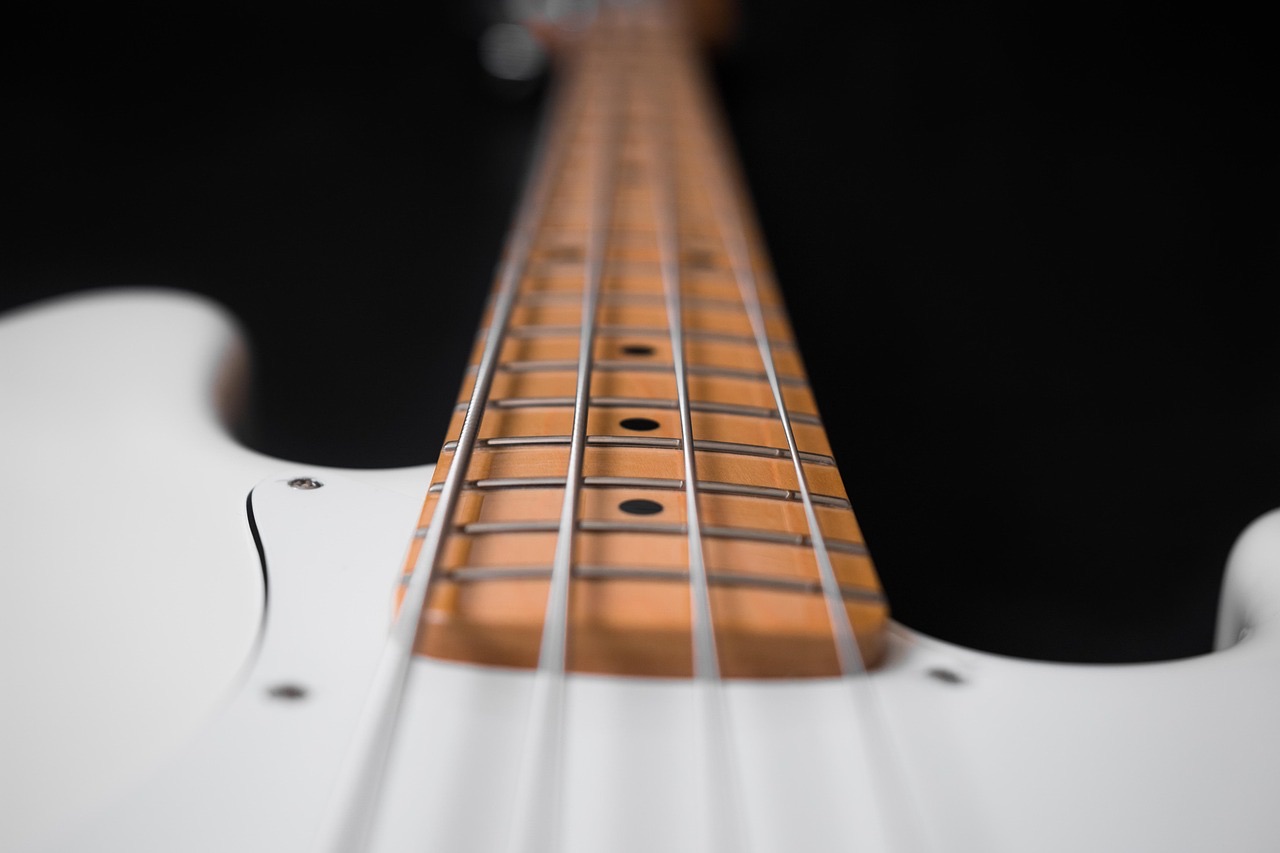
Knowing the bass guitar notes on the fretboard turns fret numbers into music: you can follow a chord chart, find a root note quickly and talk to other players in note names. This guide gives you a chart of every note on a four-string bass in standard tuning up to fret 12, the shapes that link the strings, and a practice plan to learn them one string at a time.
You need a bass in standard tuning, E A D G from the thickest string to the thinnest. If yours isn't, start with how to tune a bass guitar.
The bass string notes: E, A, D, G
Each open string has a name. From the thickest (closest to your face) to the thinnest:
- E: the lowest, E1
- A: A1
- D: D2
- G: G2, the highest
Each string is five half steps (a perfect fourth) above the one below it. That regular spacing is what makes the fretboard patterns below work.
How bass guitar notes work on the fretboard
Western music uses 12 different notes. Each fret raises the pitch by one half step (a semitone), the smallest step in the system. The 12 notes, going up, are:
A  A♯  B  C  C♯  D  D♯  E  F  F♯  G  G♯  (A)
   B♭         D♭     E♭         G♭     A♭
Natural notes, sharps and flats
The seven natural notes are A, B, C, D, E, F and G. Between most of them is one extra note, named as a sharp (♯, a half step above) or a flat (♭, a half step below) of its neighbors: the note between A and B is both A♯ and B♭. Ascending lines are usually written with sharps and descending lines with flats, but it's the same fret either way.
There is no note between B and C or between E and F: they are already a half step apart, so they sit on neighboring frets.
Fret 12 is the octave
The 12th fret divides the string into two equal halves, and halving the length raises the note by an octave: the same note name, higher. So fret 12 on the E string is E, an octave above the open string. From fret 12 up, the pattern repeats: fret 15 is the same note as fret 3, an octave higher.
Bass fretboard notes chart (frets 0 to 12)
This chart shows the bass fret notes for each string of a four-string bass in standard tuning. Sharps are shown; each sharp is also the flat of the next note up (F♯ = G♭).
| Fret | E string | A string | D string | G string |
|---|---|---|---|---|
| 0 (open) | E | A | D | G |
| 1 | F | A♯/B♭ | D♯/E♭ | G♯/A♭ |
| 2 | F♯/G♭ | B | E | A |
| 3 | G | C | F | A♯/B♭ |
| 4 | G♯/A♭ | C♯/D♭ | F♯/G♭ | B |
| 5 | A | D | G | C |
| 6 | A♯/B♭ | D♯/E♭ | G♯/A♭ | C♯/D♭ |
| 7 | B | E | A | D |
| 8 | C | F | A♯/B♭ | D♯/E♭ |
| 9 | C♯/D♭ | F♯/G♭ | B | E |
| 10 | D | G | C | F |
| 11 | D♯/E♭ | G♯/A♭ | C♯/D♭ | F♯/G♭ |
| 12 | E | A | D | G |

4 string bass notes: the naturals only
Start with the natural notes. These are the frets to memorize first:
G|-0---2---4-5---7---9-10---12-|   G A B C D E F G
D|-0---2-3---5---7---9-10---12-|   D E F G A B C D
A|-0---2-3---5---7-8---10---12-|   A B C D E F G A
E|-0-1---3---5---7-8---10---12-|   E F G A B C D E
Read each line left to right: on the E string, fret 0 is E, 1 is F, 3 is G, 5 is A, 7 is B, 8 is C, 10 is D and 12 is E. Fill in the sharps and flats from the frets in between.
Shapes that connect the strings
Memorizing all 52 spots from the open strings to fret 12 one by one is slow. Three shapes do most of the work.
Same note, next string: five frets back
Because each string is five half steps above the one below, the note at fret 5 of any string is the same as the next open string. More generally, a note at fret n is also at fret n − 5 on the next higher string: D is at fret 10 on the E string and at fret 5 on the A string; B is at fret 7 on the E string and at fret 2 on the A string.
Yamaha's fingering guide points out the same thing from the other side: nearly every note on the bass can be played in two or three places. The exceptions are the five lowest notes on a four-string, E, F, F♯, G and G♯ (frets 0 to 4 of the E string), which exist in only one place.
The octave shape: two strings up, two frets up
To find the same note an octave higher, go up two strings and two frets:
G|-----------|
D|-------5---|   G (octave)
A|-----------|
E|---3-------|   G
E string fret 3 is G; D string fret 5 is also G, one octave higher. The same shape works from the A string to the G string: A string fret 3 (C) and G string fret 5 (C). If you know the notes on the E and A strings, this shape gives you the D and G strings for free.
Fret markers as landmarks
Most basses have dot or block inlays on the fingerboard and side dots on the edge of the neck, usually at frets 3, 5, 7, 9 and 12, with fret 12 often marked by a double dot. Learn the notes at the markers first: on the E string, G (3), A (5), B (7), C♯ (9) and E (12); on the A string, C (3), D (5), E (7), F♯ (9) and A (12).

How to learn the bass fretboard: a practice plan
Work through these in order, a few minutes a day, saying each note name out loud as you play it.
Four weeks, one string at a time
Week 1: the E string
Play the natural notes on the E string from fret 0 to 12 and back, naming each: E, F, G, A, B, C, D, E. Then call out a random natural note and find it without counting from the nut.
Week 2: the A string
Repeat on the A string: A, B, C, D, E, F, G, A. Bassists play many of their root notes on the E and A strings, so these two are the most useful to learn first.
Week 3: octaves to the D and G strings
Play each natural note on the E string, then its octave on the D string (two strings up, two frets up). Do the same from the A string to the G string.
Week 4: find every place a note lives
Pick one note, say C, and find every C between fret 0 and 12 on all four strings: A string fret 3, E string fret 8, G string fret 5 and D string fret 10. Then do the same for another note.
An exercise in tab
This line plays every C, then every G, in the first 12 frets:
G|-------------5------------------------0----12---|
D|--------10------------------5-------------------|
A|---3-----------------------------10-------------|
E|------------------8----3------------------------|
C: A3, D10, G5, E8. G: E3, D5, A10, G0, G12.
If tab is new to you, how to read bass tabs explains the lines and numbers.
The bass guitar fingerboard beyond fret 12
Yamaha's fingering guide notes that most modern four-string basses have at least 21 frets, and some have 24. Above fret 12 everything repeats an octave higher: fret 13 matches fret 1, fret 15 matches fret 3, and so on. The frets get closer together toward the body, so one hand position covers more frets up there.
Common mistakes
- Counting from the nut every time. It works but it's slow. Use the markers and the octave shape as landmarks instead.
- Learning only fret numbers. Tabs give you fret numbers; bandmates give you note names. Say the names while you play.
- Forgetting B–C and E–F. No sharp between them is the most common source of wrong notes when counting.
- Learning all four strings at once. One string at a time sticks better.
What to learn next
Once you can name notes on the E and A strings without counting, play them as patterns: the bass scales guide uses these notes to build the major scale and the pentatonic, and bass chords and arpeggios shows which notes make up each chord.
Questions
What are the notes on a 4-string bass?
The open strings of a four-string bass in standard tuning are E, A, D and G, from the thickest string to the thinnest. Each fret raises the note by a half step, so the E string gives E, F, F♯, G and so on up to E again at fret 12.
How many notes are there on the bass fretboard?
There are 12 different note names: A, A♯/B♭, B, C, C♯/D♭, D, D♯/E♭, E, F, F♯/G♭, G and G♯/A♭. They repeat in higher octaves along the neck, and most notes can be played in two or three places.
Why is there no sharp between B and C, or E and F?
B to C and E to F are already a half step apart, the smallest step in Western music, so there is no note between them. On the fretboard they sit on neighboring frets.
What note is at the 12th fret?
The 12th fret is the same note as the open string, one octave higher. The 12th fret sits halfway along the string, and halving the vibrating length doubles the pitch.
What is the fastest way to learn the bass fretboard?
Learn one string at a time, starting with the natural notes on the E and A strings, and say each note name out loud as you play it. Then use the octave shape to find the same notes on the D and G strings.
Sources
Read next
Guide
Bass scales for beginners: major, minor, pentatonic and blues
The five scales to learn first, with one movable fingering for each, tab in G and A, and a chart of their notes.
Guide
How to read bass tabs: strings, frets, symbols and rhythm
Which line is which string, what the numbers and symbols mean, and how to get the rhythm that tablature leaves out.
Guide
Bass guitar chords and arpeggios: chord tones, shapes and a chart
Which notes make up each chord, how to play them as arpeggios on a four-string bass, the two-note chords that sound good low down, and a chart to keep.