Guide
How to tune a bass guitar: standard, five-string and drop D
Standard E A D G with a tuner or by ear, the low B of a five-string, six-string tuning and drop D, with the checks that keep it in tune.
Published
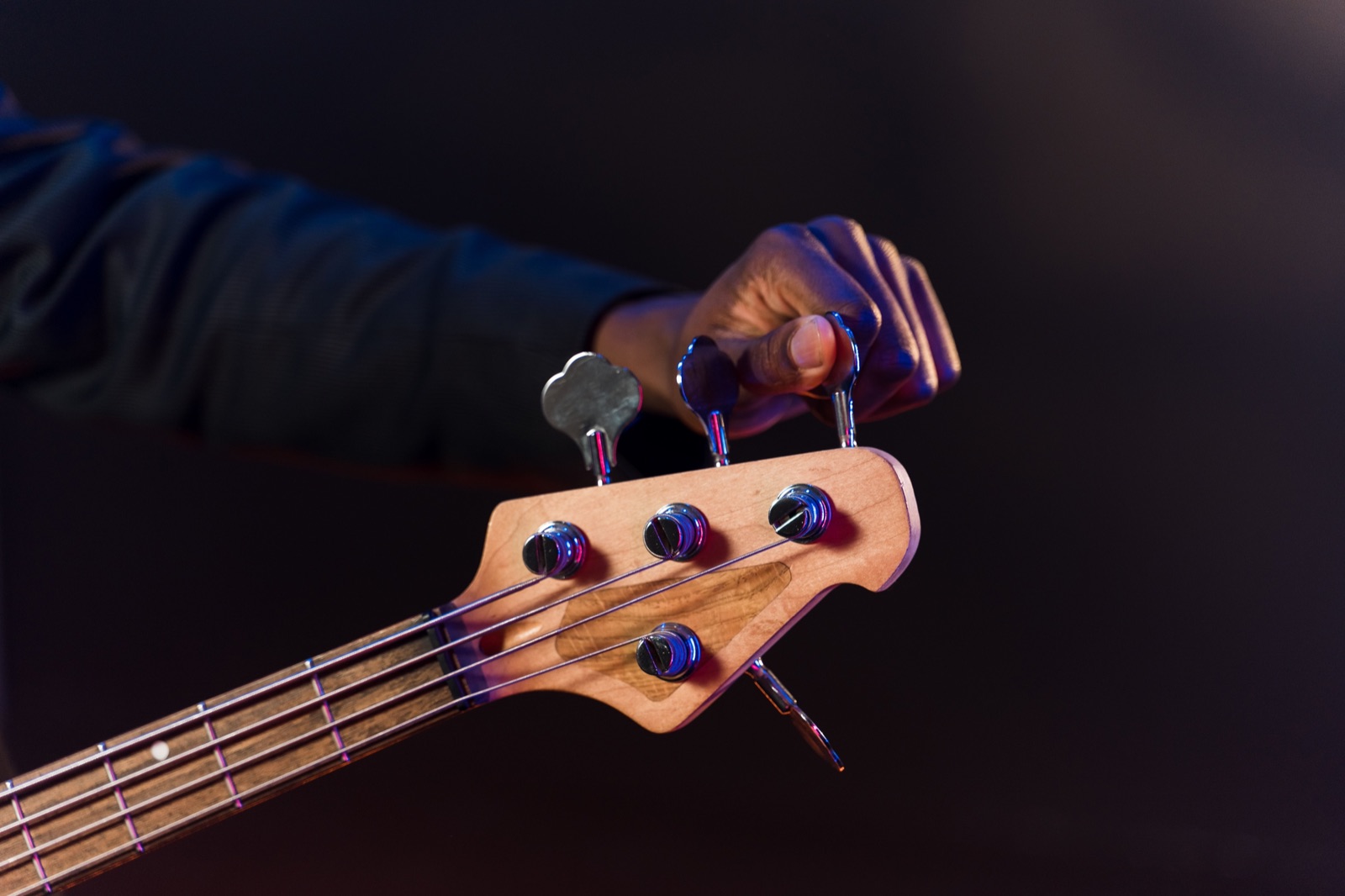
This guide shows you how to tune a bass guitar to standard tuning with an electronic tuner, how to check it by ear with the fifth-fret and harmonic methods, and how to tune a five-string, a six-string and drop D. It takes a minute once you know the routine, and you should do it every time you pick up the bass.
What you'll need
Essentials
-
Clip-on tuner
: clips to the headstock and reads the vibration of the bass, so noise in the room doesn't confuse it.
Optional
-
Pedal tuner
: sits between the bass and the amp, easier to read on stage. -
Tuner app
: works through a phone microphone; fine in a quiet room. -
Reference pitch
: a tuned piano or keyboard lets you tune by ear without a tuner.
Bass guitar standard tuning: E A D G
A four-string bass in standard tuning is tuned E, A, D, G, from the thickest string to the thinnest. The strings are a fourth apart (five half steps), and each is one octave below the matching string on a guitar.
| String | Note | Pitch | Frequency |
|---|---|---|---|
| 4th (thickest) | E | E1 | 41.2 Hz |
| 3rd | A | A1 | 55.0 Hz |
| 2nd | D | D2 | 73.4 Hz |
| 1st (thinnest) | G | G2 | 98.0 Hz |
If the order won't stick, turn the four letters into a short sentence of your own, such as "Eat All Day, Grandma". The thickest string is closest to your face when you hold the bass; the thinnest is closest to the floor.
How to tune a bass guitar with a tuner
An electronic tuner is the quickest and most accurate method, and the one to use until your ear is trained.
- Clip the tuner to the headstock, or plug the bass into a pedal tuner, and switch it on. If the tuner has modes, choose chromatic or bass.
- Turn the volume knob on the bass up if you're using a pedal tuner, since it reads the electric signal.
- Pluck the open E string firmly once and let it ring. Read the note name on the display.
- If the display shows a note below E, or E with the needle to the left (flat), tighten the string by turning its tuning key. If it shows a note above E, or the needle to the right (sharp), loosen it.
- Turn slowly and pluck again. Stop when the display shows E with the needle centered.
- Repeat for A, D and G.
- Go through all four strings a second time. Changing the tension of one string slightly changes the others.

Tune up to the note, not down
If a string is sharp, loosen it until it's below the note, then bring it back up. D'Addario's tuning guide recommends tuning gradually and bringing each note up to pitch from below, then checking the tuning again once every string is done.
Which way to turn the keys
On most basses, tightening a string means turning the key so the string winds further onto the post, but the direction depends on which side of the headstock the key is on. Turn a little while the string rings and watch the tuner: if the note goes the wrong way, turn the other way. Bass strings are thick and heavily tensioned, so small turns go a long way.
Clip-on, pedal or app
A clip-on tuner reads vibration directly from the instrument, so background noise doesn't confuse it, which makes it the easy choice for home and rehearsals. A pedal tuner reads the signal from the cable, and many can mute the output while you tune, which is handy on stage. A phone app listens through the microphone and works best in a quiet room. Tuner pedals are covered in the bass pedals guide.
How to tune a bass by ear: the fifth-fret method
Without a tuner, you can tune the bass to itself. This makes the strings agree with each other; to match other instruments, the E string must first be tuned to a reference, such as the E on a tuned piano.
Because each string is five half steps above the one below it, the note at fret 5 of one string is the same as the next open string.
G|-----------------0---|   open G = D string, fret 5
D|-----------0-----5---|   open D = A string, fret 5
A|-----0-----5---------|   open A = E string, fret 5
E|-----5---------------|
- Press the E string just behind fret 5. That note is A.
- Pluck it together with the open A string and listen.
- If you hear a wavering, pulsing sound ("beating"), the two are out of tune. Turn the A string's key until the wavering slows and stops.
- Press the A string at fret 5 (D) and tune the open D string to it.
- Press the D string at fret 5 (G) and tune the open G string to it.
Keep your fretting finger in place while you compare, and touch only the string you're fretting so the open string rings freely.
Tuning with harmonics
Harmonics give clearer, longer-ringing notes than fretted notes, which makes beating easier to hear. Yamaha's harmonics lesson describes this method, which starts from a G string tuned with a tuner or a reference:
- Lightly touch the G string directly over fret 7, without pressing it down, and pluck it. You hear a high D.
- Lightly touch the D string over fret 5 and pluck it. This is also a D.
- Tune the D string until the two harmonics match with no beating.
- Match the D string's fret-7 harmonic to the A string's fret-5 harmonic, and tune the A string.
- Match the A string's fret-7 harmonic to the E string's fret-5 harmonic, and tune the E string.
The harmonic at fret 12 is the open string's note one octave higher, which is a quick check for any string.
5 string bass tuning: B E A D G
A five-string bass is usually tuned B, E, A, D, G: standard four-string tuning with a low B (B0, about 30.9 Hz) below the E. Tune the E, A, D and G strings as above, then the B:
- With a tuner: pluck the open B and bring it to B.
- Fifth-fret method: the B string at fret 5 is E. Tune the open B until fret 5 matches the open E string.
- Harmonics: match the E string's fret-7 harmonic to the B string's fret-5 harmonic.
The low B is a heavy, slack-feeling string, so pluck it firmly and give the tuner a moment to settle.

6 string bass tuning: B E A D G C
A six-string bass is usually tuned B, E, A, D, G, C, adding a high C above the G of a five-string. The C is a fourth above G, so the fifth-fret method still works: the G string at fret 5 is C. Some players tune the top strings differently, but B E A D G C is the usual six-string tuning.
Drop D tuning
Drop D lowers only the E string, by a whole step, to D. The strings become D, A, D, G. Players use it to reach the low D and to play root-and-fifth shapes with one finger across the two lowest strings.
To tune to drop D:
- Start in standard tuning.
- Loosen the E string while plucking it until a tuner reads D.
- By ear: the open low D is an octave below the open D string. Play the low string's fret-12 harmonic, which sounds an octave above the open string, and tune it to match the open D string.
Going back to standard, tighten the low string until it reads E again. Some players fit a lever on the E tuner that drops the string quickly; Yamaha's article mentions extenders that can drop the E string as low as B.
A note on lower tunings
Tuning down further than drop D, such as B E A D on a four-string, works better with heavier strings than a standard set. Yamaha advises taking the bass to a technician to adjust the setup (truss rod, string height, intonation and nut) for substantially lower tunings. See the bass setup guide for what those adjustments mean.
Common tuning mistakes
- Tuning only once. Go round all the strings twice; each one shifts the others slightly.
- Plucking too softly or too hard. A very soft pluck fades before the tuner settles; a very hard one goes sharp for a moment. Pluck firmly and read the note as it rings.
- Tuning down to the note. Loosen below the note and come back up.
- Tuning with new strings and stopping. New strings stretch and go flat for the first days. Retune often.
- Leaving the tuner in the wrong mode. A tuner set to a guitar mode may expect different notes. Use chromatic or bass mode.
If the open strings are in tune but notes higher up the neck sound out of tune, the issue is intonation, a setup adjustment, not tuning.
What to do next
With the bass in tune, start playing: how to play bass covers both hands and your first exercises, and bass guitar notes on the fretboard shows where each note lives on every string.
Questions
What is standard tuning for a bass guitar?
Standard tuning for a four-string bass is E A D G from the thickest string to the thinnest: E1, A1, D2 and G2. These are the same note names as the four lowest guitar strings, one octave lower.
How do you tune a 5-string bass?
A five-string bass is usually tuned B E A D G, which is standard four-string tuning with a low B added below the E. The B string's fifth fret is E, so you can check it against the open E string.
How is a 6-string bass tuned?
A six-string bass is usually tuned B E A D G C: a five-string tuning with a high C added above the G. Some players use other tunings, but this is the common one.
What is drop D tuning on bass?
Drop D lowers only the E string by a whole step to D, giving D A D G. The other three strings stay in standard tuning.
How often should I tune my bass?
Every time you play, and again after any big change in temperature or after fitting new strings, which stretch and go flat for the first days.
Sources
Read next
Guide
How to play bass: your first notes, hands and practice routine
Get the bass in tune, set up both hands, play your first notes in time and learn what to practice each day after that.
Guide in Strings & setup
How to restring a bass: change your bass strings step by step
Remove the old set, thread each new string through the bridge, cut it to length, wind it neatly down the post and tune up, with the tools for each step.
Guide
Bass guitar notes: every note on the fretboard and how to learn them
A chart of every note on the four strings up to fret 12, the patterns that make the fretboard easier to map, and exercises to learn it string by string.