Guide
Bass exercises: warm-ups, finger exercises and a daily practice routine
Six exercises in tab for the plucking hand, the fretting hand and your timing, and a routine that fits them into half an hour.
Published
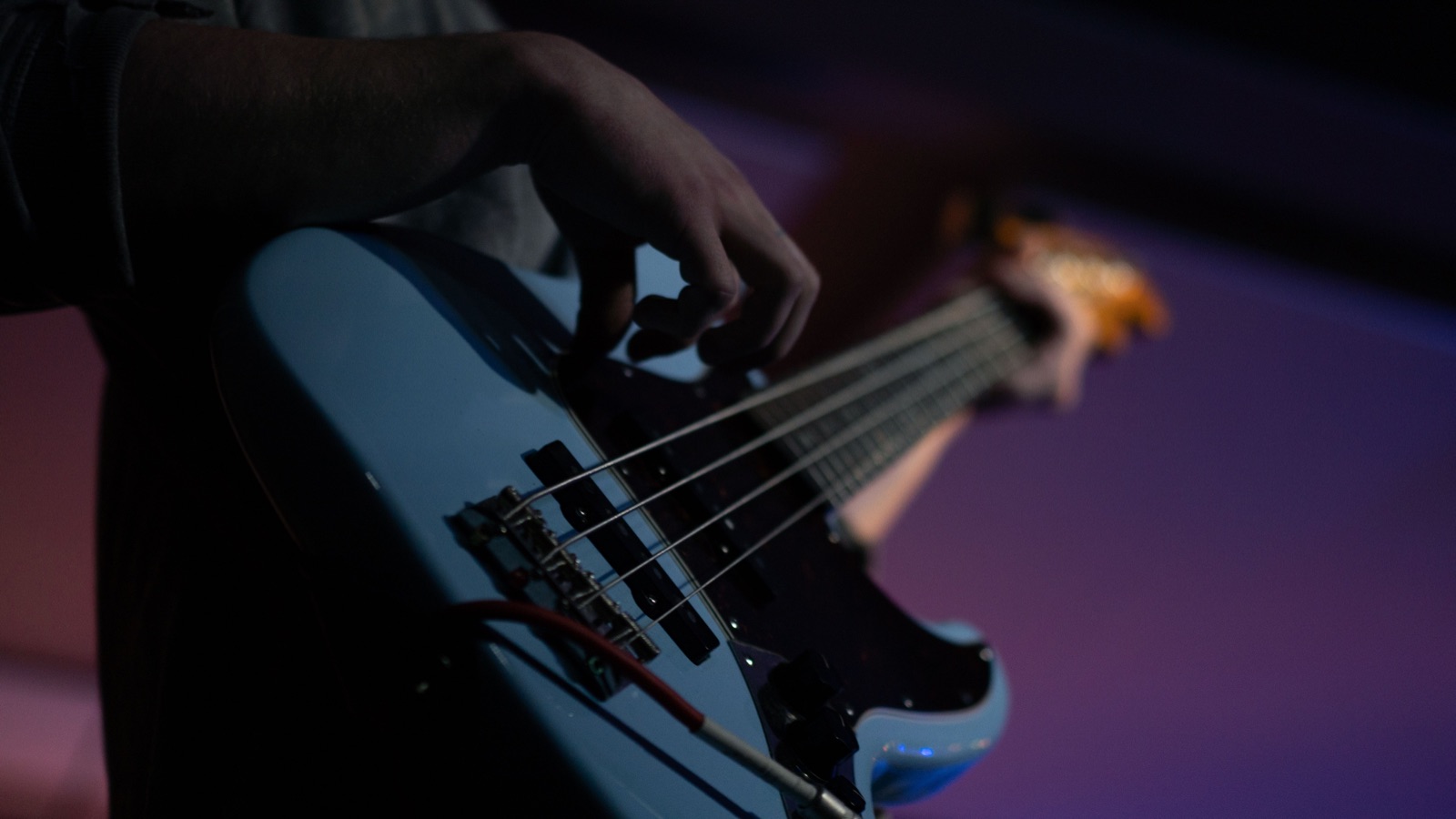
These bass exercises cover the three things every practice session needs: a warm-up for both hands, finger independence for the fretting hand, and timing with a metronome. Each comes in tab with a starting tempo, and at the end they fit into a 30-minute practice routine you can repeat every day. They work for beginners from the first weeks, and they stay useful as warm-ups long after.
Yamaha's tips for beginning bassists put it plainly: there's no substitute for regular, consistent practice. Short daily sessions with the same core exercises do more than a long weekend session.
All tab is for a four-string bass in standard tuning (E A D G). Under each tab, i and m are the index and middle fingers of the plucking hand, and 1 2 3 4 are the fingers of the fretting hand (1 is the index finger). If tab is new to you, read how to read bass tabs first.
What you'll need
Essentials
-
Bass and amp or headphone amp
: you need to hear every note clearly to tell whether it's even. -
Metronome or metronome app
: every exercise here is played to a click; it's how you measure progress. -
Tuner
: tune before each session so the exercises train your ear correctly.
Optional
-
Practice notebook
: writing down the tempo you reached on each exercise shows progress from week to week.
Bass guitar warm-up exercises
Warm up for five minutes before anything fast. Cold hands play tense, and tension is what makes notes uneven.
Exercise 1: open strings, alternating fingers
Bass Guitar For Dummies starts its warm-ups with same-string strokes: pluck each string with the index and middle fingers in turn, one finger at a time, and keep the sound even as you alternate. Its advice on the stroke: strike into the instrument rather than pulling the string up, and don't lift the fingers high and slap them down, which causes fret noise.
G|-----------------|-----------------|-----------------|-0---0---0---0---|
D|-----------------|-----------------|-0---0---0---0---|-----------------|
A|-----------------|-0---0---0---0---|-----------------|-----------------|
E|-0---0---0---0---|-----------------|-----------------|-----------------|
   i   m   i   m     i   m   i   m     i   m   i   m     i   m   i   m
Start at 60 beats per minute, one note per click. Then play two notes per click (eighth notes). Listen for the index and middle fingers sounding exactly the same.
Exercise 2: the chromatic 1-2-3-4
The most common fretting-hand warm-up. Put your first finger on fret 5 of the E string and play frets 5, 6, 7 and 8 with fingers 1, 2, 3 and 4, then the same on the A, D and G strings.
G|-----------------|-----------------|-----------------|-5---6---7---8---|
D|-----------------|-----------------|-5---6---7---8---|-----------------|
A|-----------------|-5---6---7---8---|-----------------|-----------------|
E|-5---6---7---8---|-----------------|-----------------|-----------------|
   1   2   3   4     1   2   3   4     1   2   3   4     1   2   3   4
Then come back down, fingers 4-3-2-1 on each string from the G string to the E:
G|-8---7---6---5---|-----------------|-----------------|-----------------|
D|-----------------|-8---7---6---5---|-----------------|-----------------|
A|-----------------|-----------------|-8---7---6---5---|-----------------|
E|-----------------|-----------------|-----------------|-8---7---6---5---|
   4   3   2   1     4   3   2   1     4   3   2   1     4   3   2   1
Fret 5 is a good start because the frets are closer together there than at the nut. When it's comfortable, move the whole exercise down one fret at a time toward fret 1, where the stretch is wider. Keep each finger pressed until the next note sounds, and keep the thumb behind the neck rather than wrapped over it.
Bass guitar finger exercises for independence
Exercise 3: finger permutations
Playing the four fingers in a different order trains each one to move on its own. Dummies lists all 24 orders of fingers 1, 2, 3 and 4 as a warm-up, practiced one at a time across all four strings, and notes that you can play them anywhere on the neck. Its advice: keep the fretting hand as relaxed as possible, and keep the fingers lightly touching the strings so the open strings don't hum.
Here is 1-3-2-4 on the E and A strings, first finger on fret 5:
G|-----------------|-----------------|
D|-----------------|-----------------|
A|-----------------|-5---7---6---8---|
E|-5---7---6---8---|-----------------|
   1   3   2   4     1   3   2   4
Continue on the D and G strings. Add one new order a day: 1-2-4-3, 1-4-3-2, 2-1-3-4 and so on. The orders that feel hardest (often the ones with fingers 3 and 4 next to each other) are the ones that need the work.
Yamaha's fingering guide notes that one finger per fret is how many bassists are taught, but suggests finding fingerings that suit your own hand and your bass's neck. If the stretch at fret 5 hurts, start higher up and come down gradually.
Exercise 4: string crossing with root, fifth and octave
This one is for the plucking hand. Dummies' string-crossing warm-up gives two rules: alternate index and middle when you stay on a string or move to a higher one, and rake (use the same finger) when you move from a higher string to a lower one. Here we keep strict alternation to train evenness across strings.
The notes are G, D, G, D on the E, A and D strings, then the same shape from C on the A string:
G|-----------------|---------5-------|
D|---------5-------|-----5-------5---|
A|-----5-------5---|-3---------------|
E|-3---------------|-----------------|
   i   m   i   m     i   m   i   m
This is the root, fifth and octave shape, the first pattern most bass lines are built on. Fret the root with your second finger and the fifth and octave with your fourth finger, or with your third if it's more comfortable.
Bass exercises for timing with a metronome
Yamaha's tips recommend practicing grooves and patterns to a metronome to internalize your sense of time and accuracy. Steady time is a large part of what a band needs from the bass.
Exercise 5: subdivisions on one note
Set the click to 70. On the open A string, play:
- One note per click (quarter notes) for four bars.
- Two notes per click (eighth notes), counting "1 & 2 & 3 & 4 &".
- Three notes per click (triplets), counting "1 & a 2 & a".
- Four notes per click (sixteenth notes), counting "1 e & a 2 e & a".
G|---------------------------------|
D|---------------------------------|
A|-0---0---0---0---0---0---0---0---|
E|---------------------------------|
   1   &   2   &   3   &   4   &
Change between them without stopping. The goal is that each subdivision lands exactly between the clicks; most people rush when the notes get faster.
Exercise 6: the click on 2 and 4
Halve the metronome tempo and hear each click as beats 2 and 4 of the bar, the beats a drummer usually plays on the snare. Play exercise 4 against it. Now the click doesn't tell you where beat 1 is, so you have to keep it yourself. When this feels steady, your time is starting to stand on its own.
Record and listen
Once a week, record yourself playing an exercise to the click with your phone. Listening back shows rushed notes and uneven volume that you don't hear while playing.

A 30-minute bass practice routine
Twenty to thirty minutes a day is a reasonable place to start. Here is one way to spend 30:
| Minutes | What to play | Exercises |
|---|---|---|
| 0–5 | Warm-up | 1 and 2, slow |
| 5–10 | Fretting hand | 3, one or two permutations |
| 10–15 | Plucking hand | 4, then 1 at a faster tempo |
| 15–20 | Timing | 5 or 6 |
| 20–25 | Something new | A scale, an arpeggio or a new line |
| 25–30 | Songs | Play along with recordings |
For the "something new" slot, work through bass scales and then chords and arpeggios. For songs, Yamaha suggests playing along with recordings of bassists whose playing you admire; easy bass songs has a list to start with.
How to raise the tempo
Write down the tempo at which you can play each exercise cleanly three times in a row. Raise it by a few beats per minute only when that's true. If it falls apart, go back down; speed comes from clean repetitions, not from forcing it.
Common mistakes
- Skipping the warm-up and going straight to fast songs.
- Practicing without a click. Exercises played freely feel fine and are usually uneven.
- Squeezing the neck. Press only as hard as you need for a clean note. If your hand tires quickly, you're pressing too hard.
- Always the same exercises in the same order. Rotate them so each hand and each kind of exercise gets attention over the week.
- Playing through pain. Stop, rest and loosen up; if pain in your hand, wrist or arm keeps coming back, see a doctor.
What to practice next
When these exercises feel easy at 100 beats per minute in eighth notes, add a technique you don't play yet: bass guitar technique covers muting, raking and the pick, and slap bass has its own exercises. A practice amp with a headphone output makes it easy to practice daily without bothering anyone.
Questions
What are good warm-up exercises for bass guitar?
Start with slow alternating plucks on the open strings, then a chromatic exercise with one finger per fret across all four strings. Five minutes at a comfortable tempo is enough to get both hands moving before you play faster material.
How long should I practice bass each day?
Twenty to thirty minutes a day is a reasonable starting routine, split between warm-up, technique, timing and songs. Short daily sessions work better than one long session a week.
What are bass guitar finger exercises?
Finger exercises train the fretting hand to place each finger independently. The usual ones are the chromatic 1-2-3-4 pattern and its permutations, such as 1-3-2-4, played one finger per fret across the strings.
How do I practice bass with a metronome?
Start slowly enough to play every note cleanly, one note per click. Then play two notes per click, and raise the tempo a few beats per minute only when the exercise is even. Setting the click to beats 2 and 4 is a good next step.
What should a bass practice routine include?
A warm-up, a technique exercise for each hand, timing work with a metronome, something new (a scale, a chord shape or a line) and time spent playing songs. Rotate the exercises so every part gets attention during the week.
Sources
- Dummies — How to warm up on the bass guitar with right-hand same-string strokes
- Dummies — How to warm up on the bass guitar with right-hand string crossing
- Dummies — How to warm up on the bass guitar with left-hand finger permutations
- Yamaha Hub — Tips for the beginning bassist
- Yamaha Hub — Bass fingering 101
Read next
Guide
Bass guitar technique: fingerstyle, muting, the pick and the fretting hand
How each hand does its job: plucking with fingers or a pick, keeping the other strings quiet, and fretting clean notes without strain.
Guide
Bass scales for beginners: major, minor, pentatonic and blues
The five scales to learn first, with one movable fingering for each, tab in G and A, and a chart of their notes.
Guide
How to play bass: your first notes, hands and practice routine
Get the bass in tune, set up both hands, play your first notes in time and learn what to practice each day after that.