Guide
Bass guitar technique: fingerstyle, muting, the pick and the fretting hand
How each hand does its job: plucking with fingers or a pick, keeping the other strings quiet, and fretting clean notes without strain.
Published
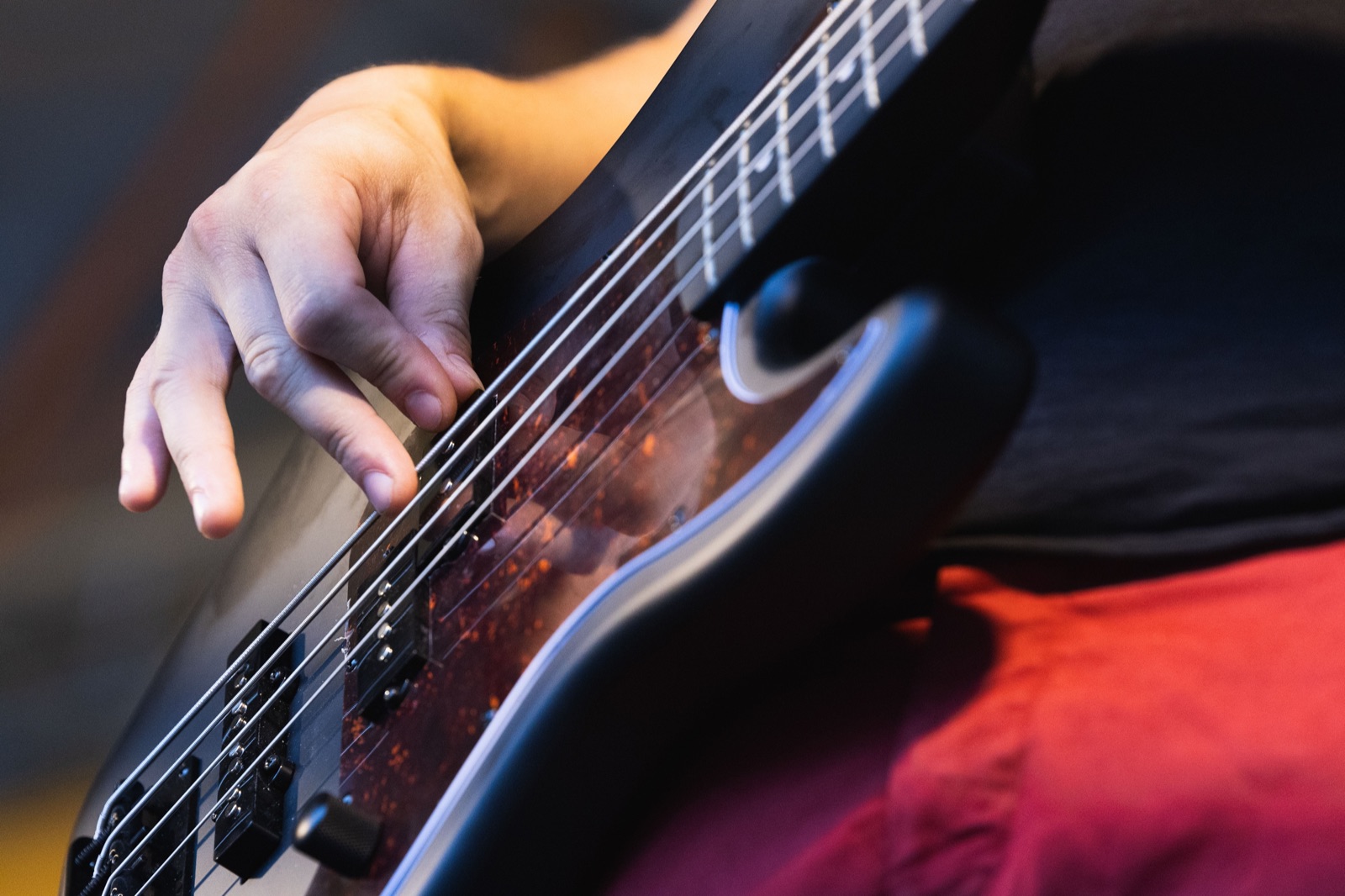
Good bass guitar technique comes down to two hands doing separate jobs: the plucking hand sets the rhythm and the tone, the fretting hand picks the note, and both keep the strings you aren't playing quiet. This guide covers fingerstyle alternation and raking, where to put the plucking thumb, muting with both hands, playing with a pick, and fretting-hand position, each with a short exercise in tab. It picks up where how to play bass leaves off.
Tab is for a four-string bass in standard tuning (E A D G). Under the tab, i and m are the index and middle fingers, and D and U are downstrokes and upstrokes with a pick.
What you'll need
Essentials
-
Bass and amp or headphone amp
: muting problems are hard to hear unplugged; an amp shows every string that rings when it shouldn't. -
Metronome or metronome app
: technique is judged by evenness, and a click shows when notes rush or drag.
Optional
-
Picks of a few thicknesses
: picks feel and sound different; trying a few is the only way to find one you like.
Fingerstyle: the plucking hand
Hand position
Bass Guitar For Dummies describes the starting position for fingerstyle: rest your thumb on the thumb rest or the edge of the pickup and let the weight of your arm settle onto it. Keep the wrist at roughly a 45-degree angle, the fingers gently curved with the fingertips pointing toward the floor, and the elbow next to your body rather than behind it.
The thumb works as a measuring device: once it's in place, you find the strings by feel instead of by looking. To reach the G string, the thumb bends a little and the hand pivots out on it; to reach the E string, the hand pivots back toward the body.
Alternating index and middle fingers
Alternate the index and middle fingers, one stroke each, even when you stay on one string. Dummies' advice for the stroke: strike into the instrument for a full, round tone, rather than pulling the string up, and don't lift the fingers high and slap them down, which causes fret noise. After a stroke, the finger comes to rest on the next lower string (the next thicker one), which also keeps that string quiet.
G|---------------------------------|---------------------------------|
D|---------------------------------|-7---7---7---7---7---7---7---7---|
A|-5---5---5---5---5---5---5---5---|---------------------------------|
E|---------------------------------|---------------------------------|
   i   m   i   m   i   m   i   m     m   i   m   i   m   i   m   i
Play D on the A string (fret 5), then A on the D string (fret 7), as eighth notes at 70 beats per minute. The second bar starts with the middle finger, so you practice both starting fingers. The two fingers should sound identical in volume and tone.
Raking: crossing strings
Strict alternation gets awkward when a line moves across strings. Dummies' string-crossing warm-up gives the rule many players use: alternate fingers when you stay on a string or move to a higher one, and rake, using the same finger, when you move from a higher string to a lower one. The finger plays a string, falls through onto the next lower string and plays that one too.
G|-------------4---|-4---------------|
D|---------5-------|-----5-----------|
A|-----5-----------|---------5-------|
E|-3---------------|-------------3---|
   i   m   i   m     i   i   i   i
These are the notes of a G major chord: G, D, G, B up, alternating; then B, G, D, G down, all with the index finger. Listen for the raked notes sounding as loud and as evenly spaced as the alternated ones.
Anchored or floating thumb
Where the thumb rests changes how you mute. A No Treble article on the question sums up both approaches: anchoring the thumb on the pickup gives a stable point of reference and helps with consistency, which suits grooves on the lower strings, while a floating thumb moves freely between strings, which can help with muting and with moving to the higher strings. Its own suggestion is a mix: keep the thumb mainly on the pickup and shift it to the E string when playing the higher strings, while avoiding excessive movement.
Bass guitar muting with both hands
Bass strings ring for a long time, and an open string you brushed or that vibrates in sympathy will hum under the next note. Muting is shared between the hands: roughly, the plucking hand keeps the lower (thicker) strings quiet and the fretting hand the higher ones.
Plucking-hand muting
- The resting finger: after each stroke, the plucking finger lands on the next lower string and mutes it.
- The thumb: on the E string, or moving across the low strings with a floating thumb, it keeps them quiet while you play higher up.
- Palm muting: TalkingBass describes a different sound, not just silence: press the heel of the plucking hand onto the strings and pluck with the thumb. Notes become short and heavy, with a quick decay; the lesson links the sound to Motown bass lines and to imitating an upright bass.
Fretting-hand muting
- Release to stop a note: lift the fretting finger just enough for the string to leave the fret, but keep touching it. The note stops cleanly. Lifting the finger off completely lets the open string ring.
- Spare fingers: TalkingBass describes fretting a note with the first finger and resting the other fingers lightly across the strings. Press those resting fingers harder and the note gets more muted, until it becomes a ghost note, a pitchless click.
- Dead notes in a groove: Dummies' raking exercise asks you to mute the string you cross by touching it lightly with at least two fingers of the fretting hand, so the rake adds a percussive click instead of a note.
Muting exercise: octave jumps
G|---------------------------------|
D|-----5-------5-------5-------5---|
A|---------------------------------|
E|-3-------3-------3-------3-------|
Play G on the E string (fret 3) and the G an octave higher on the D string (fret 5), back and forth. When you play the high G, the low G must stop: release the fretting finger and let the plucking thumb or finger rest on the E string. When you go back down, the high G must stop. You should never hear both notes at once.
How to play bass guitar with a pick
A pick gives a sharper, more even attack than fingers and is common in rock and punk.
Holding the pick
TalkingBass's beginner guide puts the pick between the thumb and the side of the index finger, pointing out at a right angle to the thumb, with only a little of the tip showing. A firmer grip suits speed, palm muting and faster rock playing; a looser one suits chords. Pick thickness is personal; try a few.
Downstrokes and alternate picking
Start with downstrokes only, one per beat, then add upstrokes between them: down on the beat, up on the "and". This is alternate picking, and it lets you play steady eighth notes without effort. Keep the motion small and from the wrist.
G|---------------------------------|---------------------------------|
D|---------------------------------|---------------------------------|
A|---------------------------------|-0---0---0---0---0---0---0---0---|
E|-0---0---0---0---0---0---0---0---|---------------------------------|
   D   U   D   U   D   U   D   U     D   U   D   U   D   U   D   U
Some players pick steady eighth notes with downstrokes only for a heavier, more uniform sound; try both and listen to the difference.
Where to pick
TalkingBass notes that picking position changes the tone: near the bridge it's tighter, toward the neck it's rounder. For palm muting with a pick, rest the edge of the picking hand lightly on the strings near the bridge.
Bass guitar fingering: the fretting hand
Position

Keep the thumb on the back of the neck, roughly behind the middle finger, and the fingers curved so the tips press the strings. Press just behind the fret wire, not on top of it; close to the fret, you need less pressure for a clean note. Press only as hard as you need for the note to stop buzzing.
One finger per fret, and shifting
Yamaha's fingering guide notes that many bassists are taught one finger per fret, which puts four frets under your fingers without moving the hand, but recommends choosing fingerings that suit your hand and your bass's neck. Low on a 34-inch scale neck the frets are wide, and some players use only the first, second and fourth fingers there, with the third usually pressing down together with the fourth. Sooner or later you have to shift to a new position; Yamaha suggests practicing those shifts so they're smooth; sliding from one note to the next is one way to move.
Bass exercises has chromatic and permutation drills for this hand. A high string height makes every note harder to fret; if your bass needs a lot of pressure, a setup may help more than practice.
Common bass guitar technique mistakes
- Plucking up and away from the body, which makes the string slap the frets. Strike into the bass.
- Using one plucking finger for everything on the same string. Alternate.
- Muting with only one hand. One hand can't cover all four strings.
- A death grip on the neck. Tension tires the hand and slows you down.
- A pick held with too much tip showing, which catches the strings and makes the attack uneven.
If playing causes pain in your hands, wrists or arms that doesn't go away with rest, stop and see a doctor.
What to practice next
Pick one area of technique per week: alternation for a week, then muting, then the pick. Practice it slowly to a metronome in the routine from bass exercises. When fingerstyle feels steady, slap bass is the next plucking-hand technique to learn.
Questions
What is the correct bass guitar technique for beginners?
Alternate the index and middle fingers when plucking, rest the thumb on a pickup or the E string, fret each note just behind the fret with one finger per fret, and keep the strings you aren't playing quiet with both hands.
How do you mute strings on bass guitar?
Use both hands. The plucking hand rests on the thicker, lower-pitched strings next to the one you're playing (the thumb, or the finger after a stroke), and the fretting hand lays its spare fingers lightly across the thinner strings. Lifting a fretting finger slightly, without letting go of the string, stops a note.
Is it OK to play bass with a pick?
Yes. Playing with a pick is a standard bass technique with a sharper attack than fingers, common in rock and punk. Hold it between the thumb and the side of the index finger with only the tip showing.
What is raking on bass?
Raking means using the same plucking finger for consecutive notes when you move from a higher string to a lower one, letting the finger fall through onto the next string. It saves motion on descending lines; when moving to a higher string, alternate fingers instead.
Should my thumb be anchored or floating when I play bass?
Both are used. Anchoring the thumb on a pickup gives a fixed reference point; a floating thumb moves across the lower strings and mutes them as you go. Many players anchor on the pickup and move the thumb to the E string when playing the higher strings.
Sources
- Dummies — How to position your right hand on a bass guitar for finger-style playing
- Dummies — How to warm up on the bass guitar with right-hand same-string strokes
- Dummies — How to warm up on the bass guitar with right-hand string crossing
- Dummies — How to rake dead notes on the bass guitar
- No Treble — Float or anchor your thumb?
- TalkingBass — 3 cool muting techniques for bass
- TalkingBass — Beginner guide to bass pick technique
- Yamaha Hub — Bass fingering 101
Read next
Guide
Bass exercises: warm-ups, finger exercises and a daily practice routine
Six exercises in tab for the plucking hand, the fretting hand and your timing, and a routine that fits them into half an hour.
Guide
How to play bass: your first notes, hands and practice routine
Get the bass in tune, set up both hands, play your first notes in time and learn what to practice each day after that.
Guide
Slap bass for beginners: thumb, pop, muting and ghost notes
The thumb, the pop and the muted notes in between, built up one at a time with four exercises in tab.