Guide
Slap bass for beginners: thumb, pop, muting and ghost notes
The thumb, the pop and the muted notes in between, built up one at a time with four exercises in tab.
Published
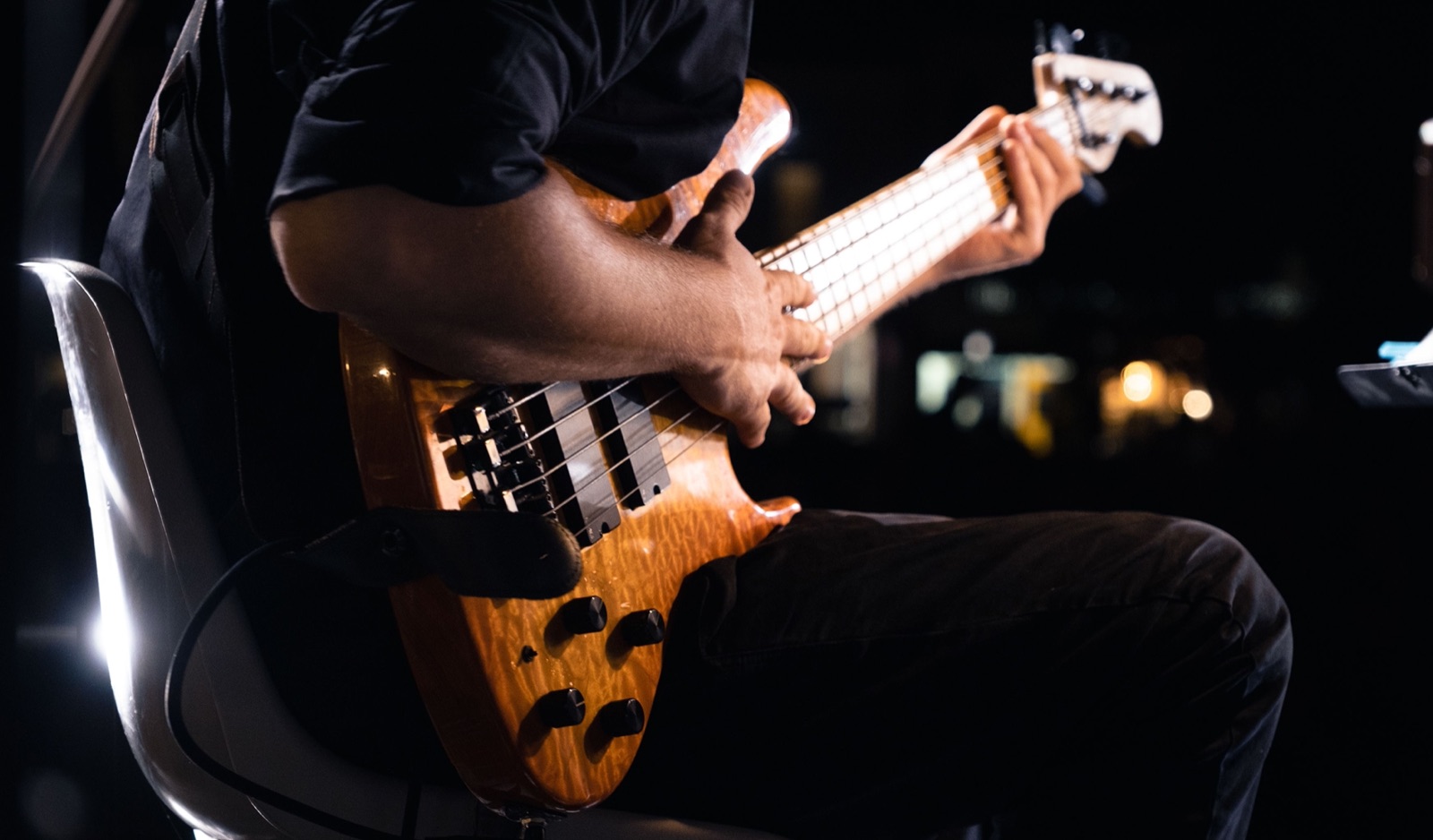
Slap bass turns the bass into part of the drum kit: the thumb strikes the low strings like a kick drum, a finger snaps the high strings like a snare, and muted notes fill the gaps. This guide builds the technique one piece at a time, the thumb slap, the pop, muting and ghost notes, with four exercises in tab. By the end you will be able to play a one-bar slap groove in time with a metronome.
All tab is for a four-string bass in standard tuning (E A D G). Under each tab, T means thumb slap and P means pop; x is a ghost note. If you're new to tablature, start with how to read bass tabs.
What you'll need
Essentials
-
Electric bass with roundwound strings
: any electric bass can slap; roundwound strings give the bright attack the technique is known for. -
Amp or headphone amp
: slapping is quiet unplugged, and you need to hear whether the ghost notes are really silent. -
Metronome or metronome app
: slap lines are rhythm parts first; the click shows whether every thumb note lands on time.
Optional
-
Compressor pedal
: evens out the jump in volume between thumb notes and popped notes.
Where slap bass comes from
Slapping is older than the electric bass. Jazz bassists in New Orleans developed it on the double bass in the early 1900s, and it later spread to western swing and rockabilly.
On the electric bass, Larry Graham is credited with inventing the technique. He calls it "thumpin' and pluckin'" and developed it after his mother decided her band would no longer have a drummer, so his thumb and fingers took over the drum parts. Graham played bass in Sly and the Family Stone from 1967 to 1972, and the technique spread quickly through funk and disco. Wikipedia's article on him says the slap-and-pop style "has become the archetype of modern funk".
Set up your plucking hand for slap bass
Slap bass technique uses the same bass and the same strings as fingerstyle, but the plucking hand moves differently. Players vary in the details; this is a common starting point.
- Hand position: bring your hand over the end of the fingerboard, where the neck meets the body. The strings have the most room to move there and snap against the frets easily.
- Thumb: hold it roughly parallel to the strings, with the side of the thumb (the knuckle area) facing the string you will hit.
- Fingers: curl the index and middle fingers loosely over the D and G strings, ready to hook under one of them.
- Motion: the movement comes from turning the forearm, like turning a door handle, more than from the thumb itself. A stiff thumb and a loose wrist are easier to control than the other way round.
Set the amp a little quieter than for fingerstyle. Slapped notes have a sharp peak, and a loud amp hides whether your muting is working.
The thumb slap
Seymour Duncan's lesson on the thumb describes the basic motion: strike the string with the side of your thumb, in a downward motion, and let the thumb go through the string and come to rest on the next string. Slapping the E string, your thumb ends up resting on the A string. The note rings, and the resting thumb keeps the A string quiet.
Some players strike and pull the thumb back off the string instead. Both work; the strike-through version is easier to keep quiet, so start with it.
Exercise 1: thumb on the open strings
Set the metronome to 60 beats per minute. Slap the open E string once on each click, then the open A string.
G|-----------------|-----------------|
D|-----------------|-----------------|
A|-----------------|-0---0---0---0---|
E|-0---0---0---0---|-----------------|
   T   T   T   T     T   T   T   T
Listen for three things: every note at the same volume, no buzz from the other strings, and each slap right on the click. When it's even, double the notes: two slaps per click.
The pop
The pop is the snare to the thumb's kick drum. Hook the tip of your index finger (or middle finger) just under the D or G string, pull it away from the body and let go. The string snaps back against the frets with a bright crack. Wikipedia's description of the technique puts the slap on the lower E and A strings and the pop on the higher D and G strings, which is where most beginner patterns stay.
Pull only far enough for the string to slap back against the frets. Berklee Online's slap lesson makes the point that pulled notes should not be louder or more intense than thumb notes; a pop that jumps out above the thumb is the most common sound of a beginner slapping.
Exercise 2: octaves
The octave is the classic slap shape: the thumb plays a root on the E or A string, and the pop plays the same note an octave higher, two strings up and two frets higher. Here the thumb slaps A (E string, fret 5) and the finger pops the A an octave above (D string, fret 7); then the same shape moves to D (A string, fret 5, and G string, fret 7).
G|---------------------------------|-----7-------7-------7-------7---|
D|-----7-------7-------7-------7---|---------------------------------|
A|---------------------------------|-5-------5-------5-------5-------|
E|-5-------5-------5-------5-------|---------------------------------|
   T   P   T   P   T   P   T   P     T   P   T   P   T   P   T   P
Fret with your first finger on the root and your third or fourth finger on the octave. Play the line as even eighth notes: thumb on each click, pop halfway between.
Muting with both hands
Slapping hits the strings hard, and every string you aren't playing will ring along unless something stops it. Berklee's lesson puts it simply: muting strings is critical, and you should only hit the string you want to sound.
Fretting-hand muting
Lay the unused fingers of your fretting hand lightly across the strings. They touch the strings without pressing them to the frets, so those strings can't ring. When you let go of a fretted note, relax the finger so it stays on the string; lifting it off lets the open string sound.
Plucking-hand muting
The thumb resting on the next string after a slap mutes that string. When you pop the D or G string, rest the thumb on the E or A string so the low strings stay quiet. Keep the pop finger close to the strings after it lets go, ready to touch the string it just played.
Ghost notes
A ghost note (also called a dead note) is a string struck without letting it ring. It has no pitch, only a percussive click, and it's what makes slap lines sound busier than the notes you actually play.
To play one, rest the fingers of your fretting hand on the string without pressing it down, then slap it as usual. Seymour Duncan's lesson describes this approach (slap through the string and use the fretting hand to mute it), and also a second one: strike the string and stop on it with the thumb so it can't ring. Berklee advises playing muted thumb notes with the same intensity as sounded notes; a ghost note that's too soft disappears from the groove.
Exercise 3: thumb, ghost, pop
Keep the click at 60 and play even eighth notes. The x is a ghost note on the E string: lay your fretting fingers over it and slap as normal.
G|---------------------------------|
D|---------2---------------2-------|
A|---------------------------------|
E|-0---x-------0---0---x-------0---|
   T   T   P   T   T   T   P   T
   1   &   2   &   3   &   4   &
The pop on beats 2 and 4 is the E an octave above the open string (D string, fret 2), the same place a snare drum usually hits.
Exercise 4: a one-bar slap groove
This groove uses notes from the E minor pentatonic scale (E G A B D) and puts all three moves together: thumb notes on the E and A strings, ghost notes, and pops.
G|---------------------------------|
D|---------2---------------5-------|
A|-----------------0---x-------2---|
E|-0---x-------3-------------------|
   T   T   P   T   T   T   P   T
   1   &   2   &   3   &   4   &
The notes are E, ghost, E (popped), G, A, ghost, G (popped), B. Put your first finger at fret 2: it plays the popped E and the B, your second finger plays the G at fret 3, and your fourth finger the popped G at fret 5. If the scale is new to you, bass scales shows the full pentatonic shape.

How to practice slap bass
Slow and even
Start every exercise at 60 beats per minute and raise the tempo a few beats at a time only when every note is even and the open strings stay quiet. Ten minutes of slap a day inside a normal practice session is enough to start; the bass exercises guide has a routine to fit it into.
Record yourself
Slap sounds louder and cleaner under your hands than it does from across the room. A phone recording shows which pops jump out and which ghost notes vanish.
Make up your own lines
Berklee suggests building your own slap lines from the root, fifth and octave of each chord. Take the octave shape from exercise 2, move it to the chords of a song you know, and add ghost notes between.
Common mistakes
- Slapping too hard. A heavy thumb gives fret buzz and string rattle, not a bigger sound. Let the amp provide the volume.
- Pops louder than thumbs. The pop needs far less force than it seems. Pull the string a short way.
- Forgetting the unplayed strings. If you hear a hum under your notes, one hand isn't muting. Check the fretting hand first.
- Rushing the ghost notes. They are notes in the rhythm, not decoration. Count them.
- Slapping with the fingertip of the thumb. Use the side of the thumb, near the knuckle.
What to work on next
Slap sits on top of fingerstyle basics: fretting close to the fret, muting and steady timing. If any of those feel shaky, bass guitar technique covers them. String choice changes the slap sound more than anything else on the bass; flatwound vs roundwound strings explains why, and a compressor from the bass pedals guide evens out the volume between thumb and pop.
If slapping causes pain in your hand, wrist or forearm that doesn't go away with rest, stop and see a doctor.
Questions
Is slap bass hard to learn?
The basic thumb slap and pop usually start to sound clean with regular short practice sessions. The hard part is control: keeping the unplayed strings quiet and placing ghost notes in time, which takes longer.
Who invented slap bass?
Slapping started on the double bass in New Orleans jazz in the early 1900s. On the electric bass, Larry Graham is credited with inventing the technique, which he calls "thumpin' and pluckin'", when his mother's band no longer had a drummer.
Can you slap on any bass?
Yes. Any electric bass can be slapped. Roundwound strings and a low, even string height make it easier and brighter; flatwound strings give a duller, thumpier slap.
What is the difference between slap and pop?
The slap is a strike with the side of the thumb, usually on the E and A strings. The pop is a finger hooking under the D or G string and pulling it so it snaps back against the frets.
Should I learn fingerstyle before slap bass?
It helps. Fingerstyle builds the timing, fretting and muting habits that slap depends on, and most bass parts you will play are fingerstyle or pick. Slap is easier to add once those feel natural.
Sources
Read next
Guide
Bass guitar technique: fingerstyle, muting, the pick and the fretting hand
How each hand does its job: plucking with fingers or a pick, keeping the other strings quiet, and fretting clean notes without strain.
Guide
Bass exercises: warm-ups, finger exercises and a daily practice routine
Six exercises in tab for the plucking hand, the fretting hand and your timing, and a routine that fits them into half an hour.
Comparison in Strings & setup
Flatwound vs roundwound bass strings: sound, feel and which to choose
Flats are smooth and warm, rounds are bright and ridged. Here is how the two compare, where half-rounds and nylon tapewounds fit, and how to choose for your music.