Guide
Bass pedals: the effects bass players use and the order to put them in
What each common bass effect does, why bass versions of pedals exist, and a signal chain order that keeps your low end intact.
Published
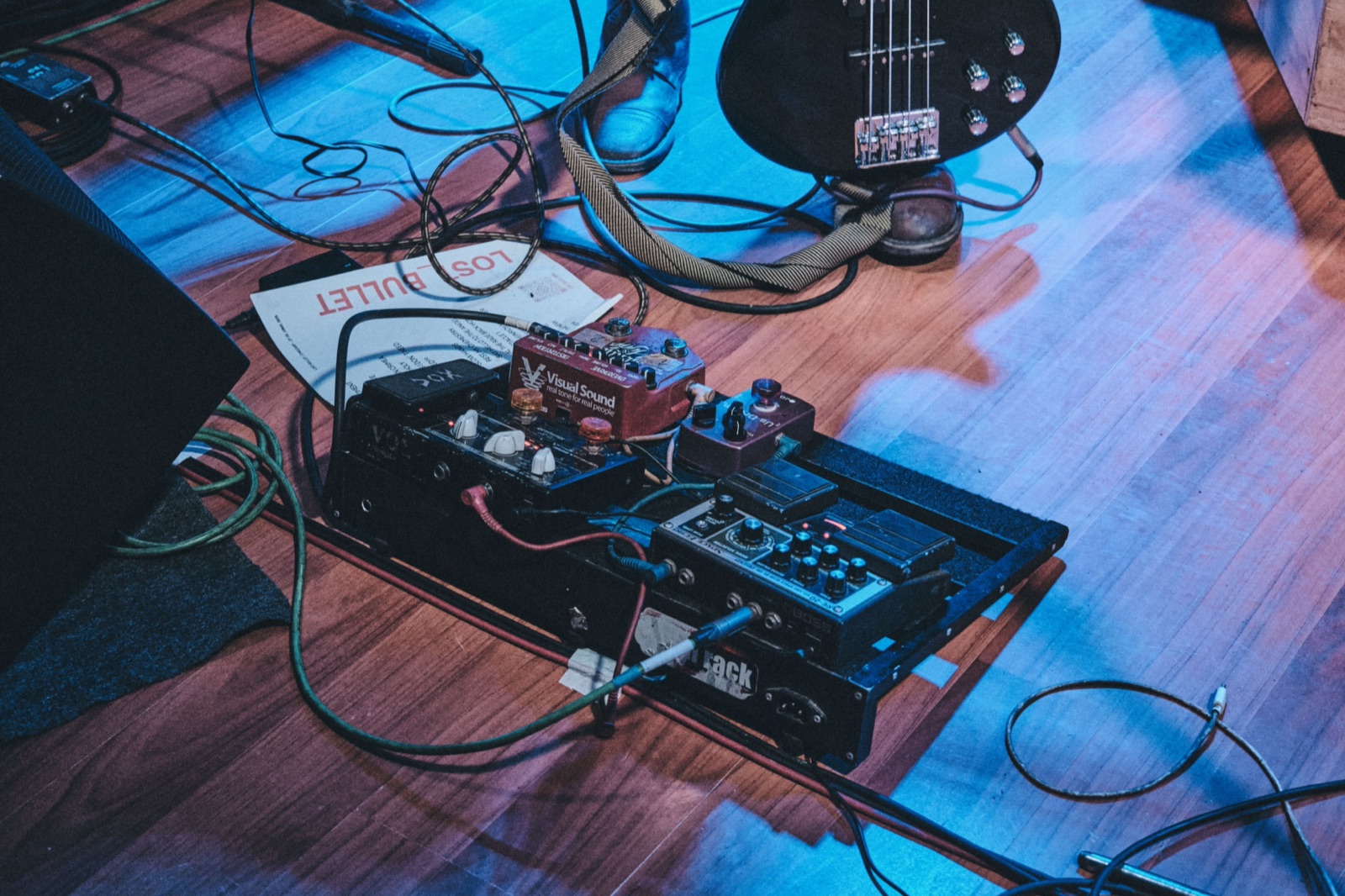
Bass pedals change your sound between the bass and the amp: they keep you in tune, even out your dynamics, add grit, drop a note an octave or make it sweep like a synth. You don't need many. By the end of this guide you'll know what the six most common bass effects do, why pedals made for bass treat the low end differently from guitar pedals, and an order to connect them in that keeps your sound clear.
What you'll need
Essentials
-
Tuner pedal
: the first pedal for most bass players; it sits first in the chain. -
Instrument cables
: one from the bass to the first pedal, one from the last pedal to the amp. -
Patch cables
: short cables that link one pedal to the next. -
Power for each pedal
: batteries or an adapter; check each pedal's manual for the right type.
Optional
-
Pedalboard
: keeps pedals and cables fixed in order so setup takes minutes. -
Earplugs
: overdrive and boost pedals can raise your volume suddenly.
Step 1: Learn the six common bass effects
Tuner
A tuner pedal mutes your signal while you tune and shows the pitch on a display. Both BOSS and Yamaha place it first in the chain; Yamaha calls this pretty much a universal rule, and BOSS notes that at the start it gets the cleanest signal and can cut the output completely while you tune.
Compressor
A compressor narrows the gap between your loudest and quietest notes. BOSS says compression makes sure the effects after it work without volume dips or spikes; Premier Guitar adds that a good compressor evens out the levels in your playing and adds sustain. It is the usual second pedal after the tuner.
Overdrive and distortion
Overdrive adds grit, from a slight edge to a heavy roar. Yamaha's guide describes it as able to conjure the sound of a gently overdriven tube amp. Distortion and fuzz go further. This is where low end is most at risk: Premier Guitar notes that loss of low frequencies is a natural consequence of any device that clips the signal, which is why bass overdrives often have a blend control.
Octave
An octave pedal adds a copy of your note an octave below, and sometimes above, mixed with the original. BOSS places it early in the chain to keep the signal it tracks clean. The BOSS OC-5, for example, has a switch that optimizes its tracking for guitar or bass, and separate knobs for the direct level and the octave voices.
Envelope filter
An envelope filter sweeps a filter according to how hard you play, giving the "quacking," funky sound often heard in funk bass. Yamaha says envelope filters and synth pedals work best placed soon after the tuner and before other effects. MXR's Bass Envelope Filter, for example, has separate Dry and Effect level controls, plus a Sensitivity knob that tailors it to your attack and to passive or active basses.
Chorus
Chorus doubles the signal with a slight, moving pitch shift for a wide, shimmering sound. It is a modulation effect, so BOSS and Yamaha both place it later in the chain. Premier Guitar suggests a little chorus works well on fretless bass. The BOSS CEB-3 is a split-frequency chorus: BOSS says it adds chorus to the higher frequencies without muddying the lows.
Step 2: Choose pedals made for bass, or adapt guitar pedals
Premier Guitar puts it bluntly: many guitar effects just don't sound that good on bass. Bass versions of pedals are nothing new, and the change is often a different capacitor value that lowers the frequency range of the effect.
| What to look for | What it does | Example from the maker |
|---|---|---|
| Blend or dry control | mixes your clean signal back in to keep the low end | BOSS ODB-3: Balance knob controls dry and overdriven sound |
| Separate dry and effect levels | same idea on filters and other effects | MXR Bass Envelope Filter: separate Dry and Effect controls |
| Split-frequency processing | applies the effect only above the lows | BOSS CEB-3: chorus on the highs, lows left alone |
| Guitar/bass mode | tunes tracking or voicing for the lower range | BOSS OC-5: guitar/bass switch |
Guitar pedals can still work on bass, especially modulation and delay. With a guitar fuzz or distortion that thins your sound, Premier Guitar's fix is to blend some of the clean signal back in. Try any pedal with your own bass and amp before deciding.

Step 3: Put your bass pedals in order
BOSS's guide to bass signal chains says there is no right way to order pedals, but gives a common order that best preserves tone:
Bass → Tuner → Compressor → Wah/Filter → Octave → Overdrive/Distortion/Fuzz
     → Noise suppressor → EQ → Modulation (chorus) → Volume → Delay → Reverb → Amp
Why each sits where it does, according to BOSS:
- Tuner first, for the cleanest signal and a full mute while tuning.
- Compressor second, so everything after it gets an even level.
- Filters and wah next, because they work best on the purest signal and color the bass tone first.
- Octave early, to keep the signal it tracks intact.
- Overdrive, distortion and fuzz after those, as the last tonal effect before modulation and delay.
- Noise suppressor after distortion, to tame hiss from high-gain pedals.
- EQ after distortion, to restore low end lost to clipping; it can also go at the very end.
- Modulation such as chorus later, because it changes the signal rather than the tone.
- Volume before delay and reverb, so it controls the level of everything ahead of it; delay and reverb last, to place the whole sound in a space.
Yamaha's guide gives a similar early order, tuner, wah, compressor, octave, distortion, which shows that filter and compressor are often swapped. Try both and listen.
Using the amp's effects loop
If your amp has an effects loop, BOSS notes that pedals placed there come after the preamp, so delays and modulation work on the amp's sound rather than being colored by it. A bass combo amp with a loop gives you that option.
Step 4: Power and connect the board
- Lay the pedals out in the chosen order before fixing anything down.
- Connect them with short patch cables, output of one to input of the next. Yamaha notes that good cables and the amp's effects loop both help avoid signal degradation.
- Power each pedal as its manual says. The BOSS ODB-3 and CEB-3, for example, run on a 9-volt battery or a BOSS PSA-series adapter.
- Turn the amp down, plug in, then switch each pedal on one at a time and set its level to match the bypassed sound.
Overdrive and boost pedals can jump your volume; long or repeated exposure to sound at or above 85 dBA can cause permanent hearing loss, according to the NIDCD, so keep levels matched and wear earplugs on loud stages.
Common mistakes
- Too many pedals too soon. A tuner and a compressor cover most needs for a long time.
- Losing the low end. If the bass disappears when a pedal is on, raise its blend or dry control, or try a bass version.
- Unmatched levels. A pedal that's louder when on sounds "better" in the shop and wrecks the mix at rehearsal.
- Mixed power supplies without checking. Using the wrong adapter can damage a pedal; check the voltage and polarity in each manual.
What to check next
If you play straight into a PA, a preamp DI pedal can sit at the end of your board; the bass DI box guide explains how. For practice at home with a few pedals, see the bass practice amp guide, and browse Amps & effects for more.
Questions
What bass pedals should a beginner get first?
A tuner pedal, then usually a compressor to even out the volume of notes. Overdrive, octave, envelope filter and chorus come later, depending on the music you play.
Can I use guitar pedals on bass?
Yes, but many lose low end, especially fuzz and distortion pedals. Pedals made for bass often add a blend or dry control, or are voiced lower, so the bottom of your sound survives.
What order should bass effects pedals go in?
A common order is tuner, compressor, filter or wah, octave, overdrive or distortion, EQ, modulation such as chorus, then delay and reverb. BOSS notes there is no single right way; this order is a starting point.
Where does a compressor go in a bass pedal chain?
Usually right after the tuner, near the start, so the pedals after it receive an even signal without volume spikes or dips.
What makes good bass pedals different from guitar pedals?
Mainly how they treat the low end. Examples include a blend control for the dry signal, as on the BOSS ODB-3, chorus applied only to the higher frequencies, as on the BOSS CEB-3, or a guitar/bass tracking switch, as on the BOSS OC-5.
Sources
Read next
Guide
Bass DI box: what it does, passive vs active, and preamp DIs like the SansAmp
How a DI turns your bass signal into one the mixer can use, which kind suits your bass, and where a preamp DI pedal fits.
Buying guide
Bass combo amp: power, speaker sizes and features for home, rehearsal and gigs
Amp and speaker in one box: how to match a bass combo's power and speaker size to where you play, and which jacks and features matter.
Buying guide
Bass practice amp: small combos, headphone amps and how much power home playing needs
A small combo, a headphone amp or a modeling amp: what each does at home, how much power quiet practice needs, and the jacks that matter.