Buying guide
Bass compressor pedal: what compression does, the controls and the types
What compression does to your bass, what each knob changes, the kinds of compressor pedal you'll find and a careful way to set one up.
Published
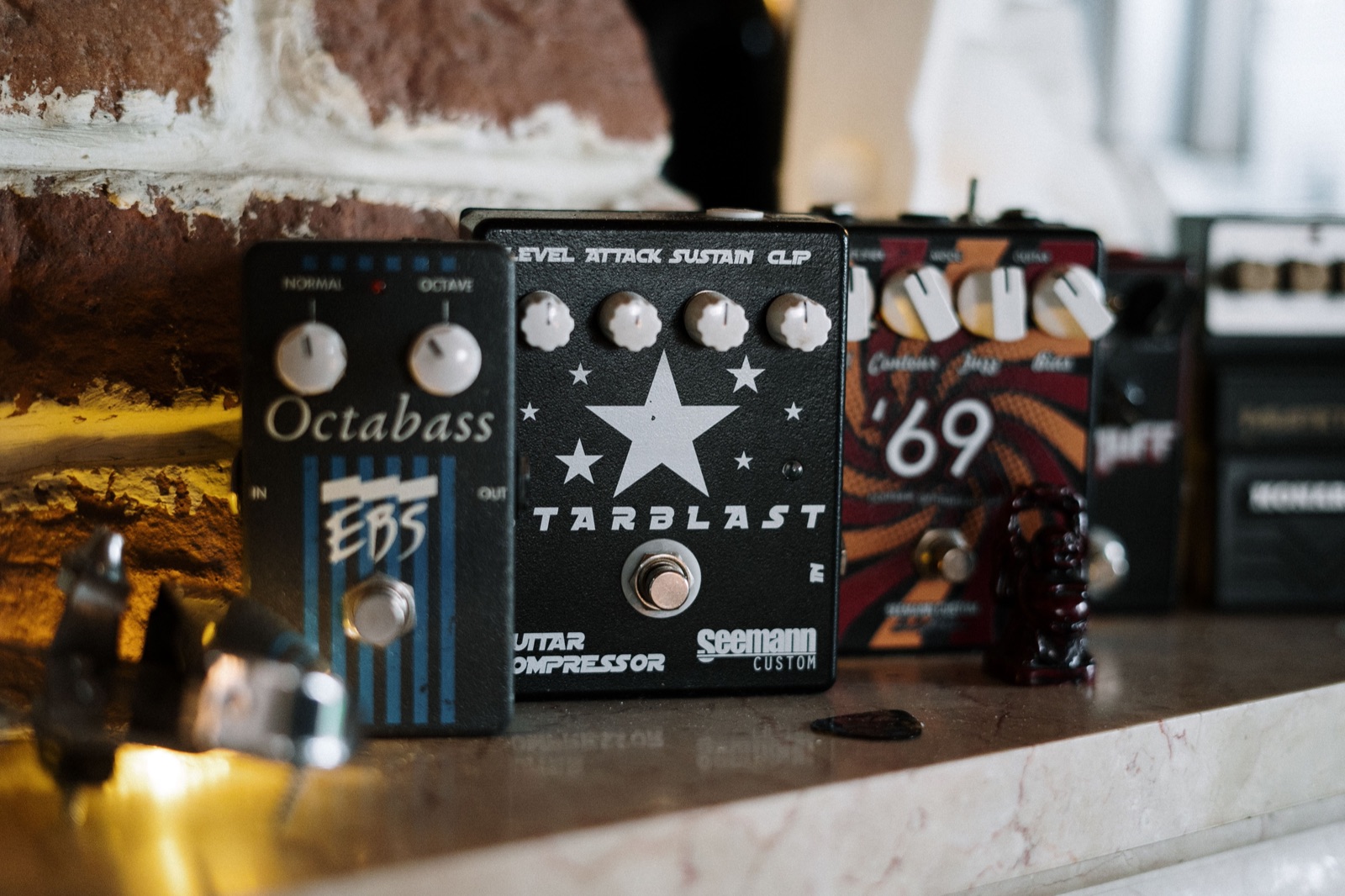
A bass compressor pedal evens out the volume of your notes. A slap that jumps out, a soft ghost note that disappears, a string that rings louder than its neighbor: compression narrows those differences so the bass sits at a steady level in the band. For many players it is the next pedal after a tuner, and one that often stays on for the whole set. This guide explains what compression does, what each control changes, the types of compressor you will see, and how to set one up without flattening the life out of your playing.
What a bass compressor pedal does
A compressor watches the level of your signal. While it stays below a set point, the threshold, nothing happens. When a note goes above it, the compressor turns that part of the signal down by an amount you choose. Yamaha's guide to bass compression lists the usual reasons: controlling overall volume, adding punch or sustain, and helping the bass blend with the kick drum. Premier Guitar adds that a good stompbox compressor evens out the levels in your playing and adds a great deal of sustain.
That sustain comes from the same process. As a note decays, it falls back under the threshold and is no longer turned down, while the output control raises the whole signal. The tail of the note stays louder for longer.
Compression is subtle at gentle settings. You may hear it less as an effect and more as your bass "sitting" in the mix: notes speak at a similar volume whether you dig in or play lightly.
The controls on a bass compressor
Pedals label their knobs differently, and simple models combine several functions into one or two knobs. These are the controls you'll meet on fuller designs.
Threshold
The level at which compression starts. Yamaha explains that a high threshold compresses only the loudest notes you play, while the lower the threshold, the more compression you get. Some pedals have an Input or Sensitivity knob instead: turning up the input pushes more of the signal over a fixed threshold, which has a similar effect.
Ratio
How hard the compressor turns down the signal above the threshold. Sound On Sound's example: at 2:1, the output rises only 1 dB for every 2 dB the input rises above the threshold. Yamaha says most bassists use somewhere between 2:1 and 4:1. Very high ratios turn a compressor into a limiter: Sound On Sound describes a very high threshold, the shortest attack and the highest ratio as a way to set a ceiling that peaks shouldn't exceed.
Attack
How quickly the compressor reacts once a note crosses the threshold, usually measured in milliseconds. A fast attack catches the front of each note. Yamaha warns that if the attack is too fast, all peaks are affected and the bass sounds unnatural, while slow attack times coax more sustain from your bass. A slower attack also usually lets more of each pluck through before the compressor reacts.
Release
How quickly the compressor lets go after the signal drops back below the threshold. Yamaha notes that the best setting depends on tempo and style, so you have to experiment, and that a poorly chosen release can make string noise more noticeable.
Output (make-up gain)
Compression makes the signal quieter, so every compressor has a way to bring the level back up. Sound On Sound notes that all compressors have this built in, usually as a control labeled make-up gain; on pedals it is usually labeled Output, Level or Volume. Set it so the pedal is no louder than the bypassed signal.
Blend or mix
A blend control mixes your uncompressed signal with the compressed one. This is parallel compression, which Sound On Sound describes as blending a heavily compressed version of the source with an uncompressed one. On bass, the compressed part usually adds sustain and evenness while the dry part keeps the attack of each note. Not every bass compressor has a blend.
Knee
Some compressors offer a soft or hard knee. Sound On Sound and Yamaha explain the difference the same way: with a hard knee, full-ratio compression starts as soon as a peak reaches the threshold; with a soft knee, compression starts gently as the signal approaches the threshold and increases gradually. A soft knee usually sounds less obvious.
Types of bass compressor
Yamaha names several compressor designs, including VCA, FET, optical and vari-mu, and says the best one for your bass sound is a subjective decision. For a pedal buyer, it's more useful to sort them by what they let you control.
| Type | Typical controls | Good for | Example from the maker |
|---|---|---|---|
| Simple compressor | one to three knobs, often level and sustain or compression amount | set-and-forget evening out | many guitar and bass compressors |
| Full-control compressor | threshold or input, ratio, attack, release, output | players who want to shape the attack and sustain | MXR M87: Attack, Release, Ratio, Input, Output |
| Multiband compressor | a few knobs over a processor that treats frequency bands separately | even lows and highs without one dominating | BOSS BC-1X: Threshold, Ratio, Release, Level |
| Compressor with blend | adds a dry/compressed mix | parallel compression, keeping your attack | various |
| Compressor inside other gear | in a multi-effects unit, a preamp or the amp itself | fewer boxes on the floor | see bass multi-effects |

Examples from makers' pages
MXR M87 bass compressor
The M87 is a common example of a full-control pedal. MXR lists five knobs (Attack, Release, Ratio, Input and Output) and ten gain-reduction LEDs, and describes the controls as covering everything from subtle peak limiting to hard, squashed compression. MXR says the pedal passes your full dynamic range unaltered until the signal reaches the threshold. It runs on a 9-volt battery or a Dunlop 9-volt adapter.
BOSS BC-1X
The BC-1X is BOSS's multiband example. BOSS describes a complex multiband processor hidden behind a simple four-knob interface (Threshold, Ratio, Release and Level), with a 12-segment gain-reduction indicator and 18-volt input electronics. Note the power: BOSS lists a current draw of 90 mA and estimates only about 2 hours of continuous use on an alkaline battery, so plan on an adapter.
What to look for
A gain-reduction meter
LEDs that show how much the pedal is turning you down make setup far easier than listening alone. Both examples above have one: ten LEDs on the M87, a 12-segment indicator on the BC-1X.
The controls you'll actually use
If you want to press a switch and play, a simple pedal is fine. If you play with a pick one night and slap the next, separate attack and release controls let you match each style. A blend control is worth having if you like your note attacks to stay sharp.
Power and current draw
Check the voltage, polarity and current in the manual before buying a power supply. Digital and multiband compressors may draw much more current than simple analog pedals, which affects battery life and which outputs of a shared power supply they can use.
Size and board space
A compressor tends to stay on your board permanently, so a compact pedal with controls you can read on a dark stage is worth more than features you never touch.
Which bass compressor suits whom
- Beginners and fingerstyle players who want an even sound: a simple compressor, or the compressor in a multi-effects unit you already own.
- Slap and pick players: a full-control pedal, so you can slow the attack to keep the click of the note and still catch the peaks.
- Players with five-strings or a wide-range sound: a multiband design, which treats frequency bands separately.
- Players who find compression "squashes" their tone: a pedal with a blend control.
Setting up a bass compressor pedal
Put the compressor right after the tuner. BOSS's guide to the bass signal chain places it second so the pedals after it receive an even signal, and the guide to bass pedals uses the same order.
- Set the output so the pedal is at unity: switching it on and off should not change the volume.
- Start gently: a ratio around 2:1 to 4:1, as Yamaha suggests, and a high threshold.
- Play your loudest notes and lower the threshold (or raise the input) until the meter shows a little gain reduction on those notes only.
- Adjust the attack: slower if the notes lose their punch, faster if peaks still jump out.
- Adjust the release so the pedal recovers in time for the next note, then match the output to the bypassed level again.
- Compare on and off at band volume, not just alone at home.
Band volume is loud: long or repeated exposure to sound at or above 85 dBA can cause permanent hearing loss, according to the NIDCD, so wear earplugs at rehearsals and gigs.
Common mistakes
- Too much compression. If every note sounds the same and your playing feels lifeless, raise the threshold or lower the ratio.
- Louder means better. A pedal that's louder when switched on always sounds impressive at first. Match levels before you judge.
- Noise and hum. Compression raises quiet sounds, including hum and string noise. Check your cables and power first, and see the bass setup guide if fret buzz is part of the noise.
A compressor before an overdrive gives the drive an even signal to work with; a preamp pedal at the end of the chain then shapes the tone that reaches the amp or PA.
Questions
What does a bass compressor pedal do?
It turns down notes that rise above a level you set, so loud and quiet notes end up closer together in volume. The result is a steadier bass line that sits evenly in the mix, often with a little more sustain.
What ratio should I use on a bass compressor?
Yamaha's guide to bass compression says most bassists use somewhere between 2:1 and 4:1. Start at the low end of that range with a high threshold, so only your loudest notes are compressed, and raise it only if you need more control.
Where does a compressor go in a bass pedal chain?
Usually right after the tuner, near the start of the chain. BOSS explains that this lets the pedals after it receive an even signal without volume dips or spikes.
What is the difference between a compressor and a limiter?
A limiter is a compressor set to work only on the very loudest peaks, with a very high threshold, a very high ratio and a fast attack, so the signal cannot pass a ceiling. A compressor at a gentler ratio shapes the dynamics of everything above its threshold.
What controls does the MXR M87 Bass Compressor have?
MXR lists Attack, Release, Ratio, Input and Output knobs and ten LEDs that show gain reduction. It runs on a 9-volt battery or a 9-volt adapter.
Sources
Read next
Guide
Bass pedals: the effects bass players use and the order to put them in
What each common bass effect does, why bass versions of pedals exist, and a signal chain order that keeps your low end intact.
Buying guide
Bass overdrive pedal: overdrive, distortion and fuzz on bass without losing the low end
Why drive pedals thin out a bass, how bass versions keep the bottom end, and how to set one so the grit sits on top of a solid low end.
Guide
Bass preamp pedal: what it does, how it differs from a DI and an amp, and how to set one up
The tone-shaping part of a bass amp in a pedal: what it adds to your rig, which features matter and three ways to connect it.