Guide
Fender Jazz Bass: two pickups, a slim neck and a growling tone
Two single-coil pickups and a slim neck: what sets the J bass apart from the Precision, how to dial in its sound, and what changes on a five-string Jazz.
Published
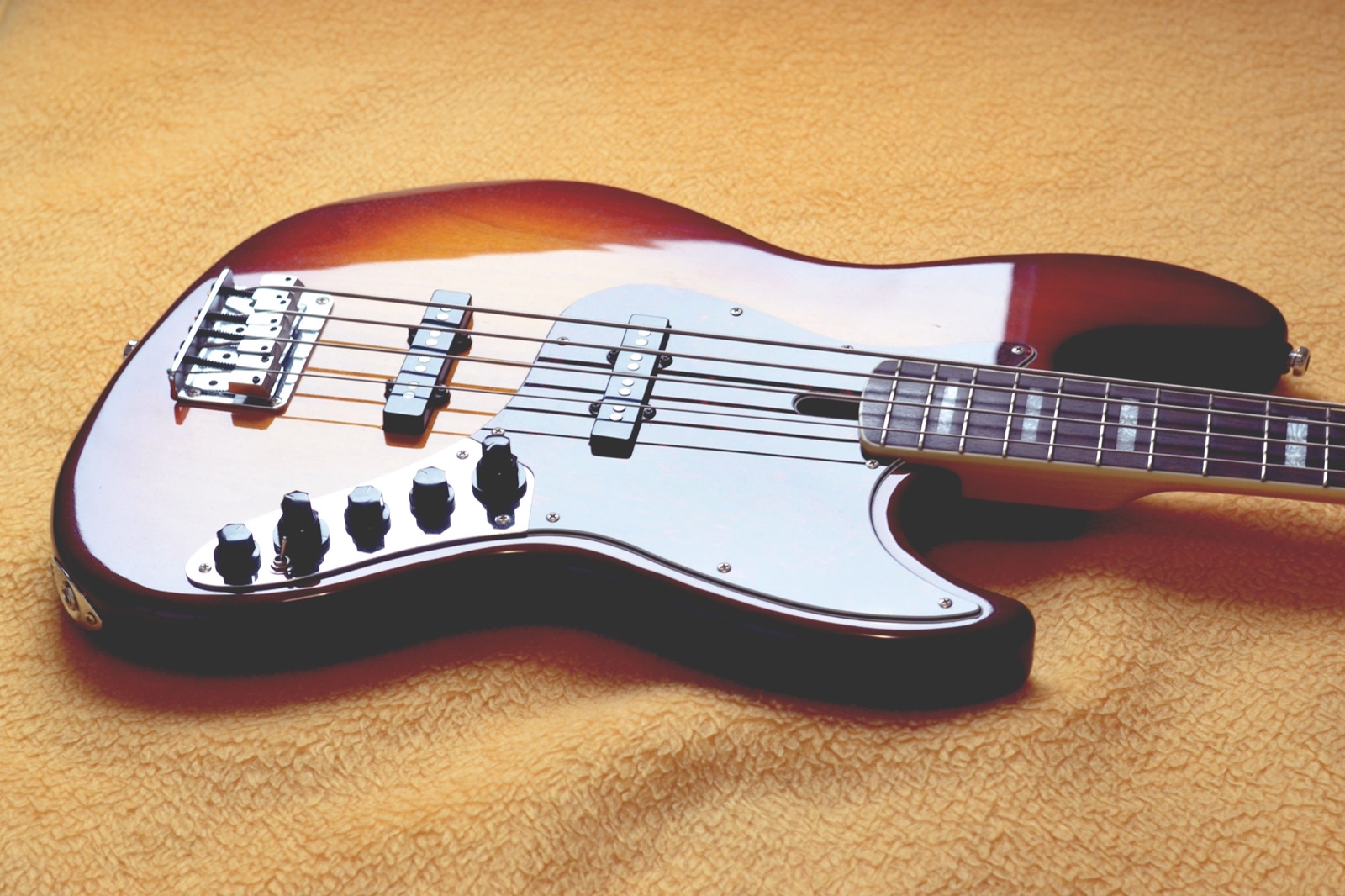
The Fender Jazz Bass, or J bass, is the second of Fender's two classic basses, introduced in 1960 as a more upscale partner to the Precision Bass. It has two pickups instead of one, an offset body and a noticeably slimmer neck at the nut. This guide explains each of those parts, how the Jazz Bass sounds and how to get its classic tones from the controls, how it compares with a P bass, and what changes on a five-string Jazz.
What makes a Fender Jazz Bass
Fender describes the first Jazz Basses as having "an offset body, narrower neck and two single-coil pickups", borrowing styling from the Jazzmaster guitar. Those three features still define the model.
Two single-coil pickups
A Jazz Bass has two narrow single-coil pickups, each running under all four strings. One sits toward the neck (some Fender spec sheets call it the middle pickup), and one sits near the bridge.
The classic wiring gives each pickup its own volume knob, plus a master tone. On the current Player II Jazz Bass, Fender lists exactly that: Volume 1 (middle pickup), Volume 2 (bridge pickup) and Master Tone. Instead of switching pickups, you blend them with the two volume knobs.
The offset body
The body's waist is offset: the two sides are not mirror images, so the body looks slightly "pushed" toward the bass side. Fender notes the sculpted contours of the first J basses. In practice the shape mostly affects how the bass sits against you when seated and on a strap; it is a matter of comfort and looks more than sound.
The narrow nut
The neck is the feature many players notice first. On Fender's current four-string Jazz Basses, the nut width is 1.5 inches (38.1 mm), compared with 1.625 inches on most current Precision Basses. The neck then widens toward the body. The narrower nut puts the strings closer together near the headstock, which many players with smaller hands find easier for reaching notes in the first few positions.
The rest of the dimensions match the P bass: a 34-inch scale and, on most models, 20 frets.
| Spec | Player II Jazz Bass |
|---|---|
| Body | Alder |
| Neck profile | Modern "C" |
| Scale length | 34 in (864 mm) |
| Nut width | 1.5 in (38.1 mm) |
| Frets | 20 |
| Controls | Volume (middle pickup), volume (bridge pickup), master tone |

The bass on this page's cover has five knobs and a small switch rather than the classic three knobs, which usually means active electronics with extra EQ controls; the pickup layout is the same.
How a Jazz Bass sounds
Fender sums up the first J basses' tone as brighter than the Precision, with a "characteristic growl". The two pickups are what give it that range.
Getting the classic tones
Start with the tone knob fully up and try these settings:
- Both volumes full up. Both pickups together give the classic scooped Jazz Bass sound: clear lows and highs, a little less midrange than a P bass. This is the usual starting point and suits slap and fingerstyle funk.
- Bridge pickup only (neck volume down). Thinner, more nasal and focused; it cuts through a busy mix and suits melodic lines and solos.
- Neck pickup only (bridge volume down). Rounder and deeper, closer to a P bass, though not the same, because it is a single coil under all four strings rather than a split coil.
- Somewhere in between. Lower one volume slightly to tilt the sound. Small changes make a clear difference.
Then use the tone knob to take off brightness. Strings matter as much as settings: roundwound strings bring out the growl, flatwounds give a smoother, older sound. See flatwound vs roundwound strings for the difference.
A note on hum
Single-coil pickups can pick up hum from lights, screens and other electronics, and it is often more noticeable with one pickup soloed. If hum bothers you, move away from the source first. Some current models, such as the Player II Modified Active Jazz Bass V, use Fender's "Noiseless" pickups designed to reduce this.
Jazz Bass vs Precision Bass
The short version: the P bass has one split-coil pickup and a slightly wider neck; the J bass has two single-coils and a narrower neck at the nut.
| Precision Bass | Jazz Bass | |
|---|---|---|
| Pickups | One split single-coil | Two single-coils |
| Usual controls | Volume, tone | Two volumes, tone |
| Nut width (current Fender 4-string) | 1.625 in | 1.5 in |
| Body | Symmetrical double cutaway | Offset waist |
| Sound | Deep, punchy, strong mids | Brighter, more varied, growly |
Choose a P bass if you want one dependable sound with minimal adjustment. Choose a J bass if you want more tonal range or a slimmer neck. If you want both, a PJ bass combines a Precision pickup with a Jazz bridge pickup; the Precision Bass guide covers it.
Five-string Jazz Bass
Many searches for a "Fender Jazz Bass 5" are after the Jazz Bass V: the same design with a fifth, lower string (usually tuned to B). Fender's current range includes Jazz Bass V models in several series, and the three compared here share the same key numbers.
What changes on a Jazz Bass V
- Wider neck. The American Professional Jazz Bass V, the Player II Modified Active Jazz Bass V and the Squier Affinity Series Jazz Bass V all list a 1.875-inch (47.6 mm) nut, against 1.5 inches on a four-string J.
- Same scale. All three keep the 34-inch scale.
- Different pickups. The pickups are wider to cover five strings, such as the V-Mod III Jazz Bass V pickups on the American Professional or the Player II Noiseless Jazz Bass V pickups on the Player II Modified.
- Often active electronics. The Player II Modified Active Jazz Bass V, for example, has a master volume, a pan pot to blend the pickups, and treble, midrange and bass boost/cut controls. The American Professional Jazz Bass V keeps the classic volume, volume, tone layout.
For whether you need the low B at all, and how to get used to it, see the five-string bass guide.
Signature models and a short history
Artist models
Fender's Jazz Bass collection includes many artist models. Two that come up often:
Geddy Lee Jazz Bass
Fender's signature model for the Rush bassist and vocalist, which Fender describes as a replica of his own instrument. A USA Geddy Lee Jazz Bass is also sold, combining features of three of his favorite basses.
Jaco Pastorius Jazz Bass
A fretless signature model for Jaco Pastorius, in 3-color sunburst with no pickguard and a pau ferro fingerboard with inlaid fret lines. For more on fretless basses, see the fretless bass guide.
Where the Jazz Bass came from
Fender introduced the Jazz Bass in spring 1960, nine years after the Precision. Fender says it was designed with jazz players in mind, but, like the Jazzmaster, it was largely overlooked by jazz musicians and caught on with funk, soul and rock players instead. From the start, it complemented the Precision rather than replacing it, and the two have been sold side by side ever since.
Common mistakes with a Jazz Bass
- Leaving one volume at zero and forgetting it. If the bass sounds thin or hums, check both volume knobs first.
- Assuming every J bass has a 1.5-inch nut. Five-string models are much wider, and some vintage-style and signature models differ; check the spec sheet.
- Comparing a passive and an active model as if they were the same. Active Jazz Basses need a battery and have extra EQ; that is a different way of working, not just a different sound.
- Skipping the setup. Neck relief and string height affect how a slim neck feels. Make small truss rod adjustments and recheck, or take it to a technician.
What to check next
Compare the Precision Bass if you are choosing between the two classic Fenders. If you want more range downward, read the five-string bass guide. For general advice on choosing an instrument, start at the basses section.
Questions
What is a J bass?
J bass is short for the Fender Jazz Bass and for basses built on its design: an offset solid body, a 34-inch scale neck that is narrow at the nut, and two single-coil pickups, one near the neck and one near the bridge.
Is a Jazz Bass neck thinner than a Precision Bass neck?
At the nut, yes. Fender's current Jazz Bass models list a 1.5-inch nut width, while most current Precision Basses list 1.625 inches. The difference is easy to feel in the lower positions.
Is a Jazz Bass good for beginners?
Yes. The narrow neck is comfortable for many hands and the two pickups give a range of tones. There are a few more controls to learn than on a P bass, but the basics come quickly.
Does Fender make a 5-string Jazz Bass?
Yes. Fender's current range includes five-string Jazz Bass V models in the American Professional, American Ultra II and Player II Modified series, and Squier makes Affinity and Classic Vibe versions. All the five-string models named in this guide list a 1.875-inch nut.
What is the Geddy Lee Jazz Bass?
It is Fender's signature model for the Rush bassist and vocalist, based on his own Jazz Bass. Fender sells it alongside a USA-made Geddy Lee version.
Sources
- Fender — A decade of innovation: Fender in the 1960s
- Fender — Legendary lows: the Precision Bass story
- Fender — Jazz Bass collection
- Fender — Player II Jazz Bass specifications
- Fender — American Professional Jazz Bass V specifications
- Fender — Player II Modified Active Jazz Bass V specifications
- Squier — Affinity Series Jazz Bass V specifications
- Fender — Geddy Lee Jazz Bass
- Fender — USA Geddy Lee Jazz Bass
- Fender — Jaco Pastorius Jazz Bass
- Fender — American Ultra II Jazz Bass V
- Squier — Classic Vibe '70s Jazz Bass V
Read next
Guide
Fender Precision Bass: what a P bass is, how it sounds and who it suits
One pickup, two knobs and a 34-inch neck: why the P bass became the default electric bass, and how to choose between the versions sold today.
Buying guide
5 string bass: what the low B adds and how to choose one
A fifth string extends the bass downward to a low B. Here is what that changes in the neck, the sound and your playing, and how to compare five-string basses.
Guide
Fretless bass: how it differs, how it sounds and how to start playing one
No frets means your fingertip sets the pitch. Here is what that changes, which fretless basses exist, and how to start playing in tune.