Guide
Bass pickups: P, J, humbucker and soapbar explained
What each common pickup layout does to the sound of a bass, why some hum and some don't, and what to check before you buy a replacement set.
Published
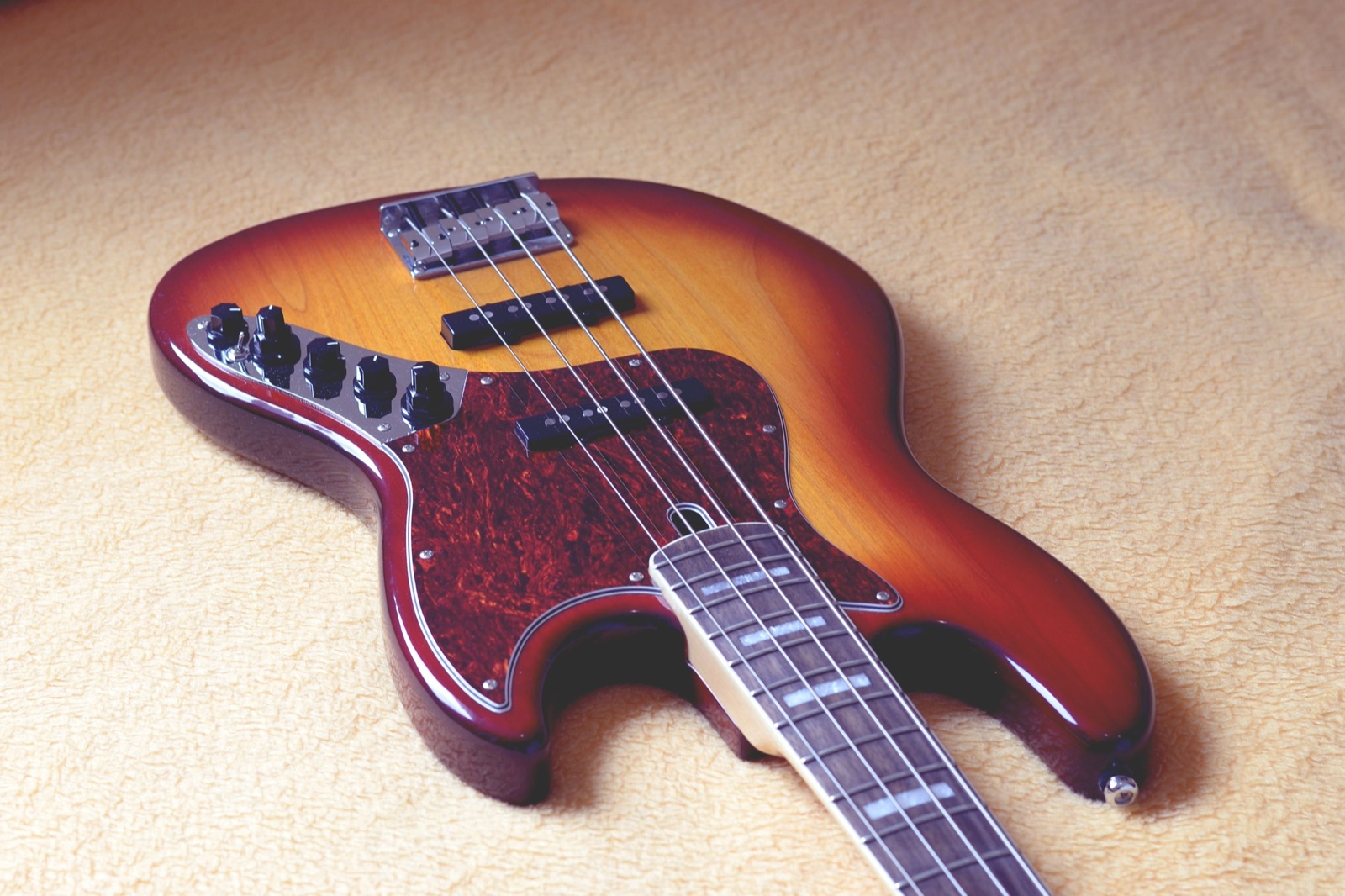
Bass pickups turn the vibration of the strings into the signal your amp hears, and their type and position shape the sound more than any other part of the electronics. This guide explains how a pickup works, the four layouts you will see on most electric basses (split-coil P, single-coil J, MM-style humbucker and soapbar), what active pickups add, and what to check before buying a replacement. By the end you should be able to look at a bass, name its pickups and know roughly how it will sound.
How a bass pickup works
A magnetic pickup is a magnet, or a set of magnetic pole pieces, wrapped in a coil of very thin wire. The magnet magnetizes the steel string above it; when the string vibrates, its moving field induces a small voltage in the coil, which is the signal that goes to the amp. That is why magnetic pickups need steel strings and why the pole pieces sit directly under the strings.
Why some pickups hum
A single coil also acts like an antenna and picks up mains hum, the buzz from household wiring, lights and screens. A humbucker solves this with two coils wound in opposite directions and with opposite magnetic polarity: the hum induces an equal voltage in both coils and cancels, while the string signal adds up, as Wikipedia's article on pickups explains. Guitar World sums up the trade: a single coil has a very open sound with a rich top end, while a humbucker bucks hum and, with its coils in series, gives a hotter signal and a fatter midrange.
The main types of bass pickups
| Type | Looks like | Coils | Hum | Typical sound |
|---|---|---|---|---|
| Split-coil P | Two offset halves, each under two strings | Two | Usually cancels | Thick, punchy midrange |
| Single-coil J | One narrow bar under all strings | One | Can hum alone | Open, clear, strong top end |
| MM-style humbucker | One large pickup with big round pole pieces | Two, side by side | Cancels | Big, aggressive, cuts through a band |
| Soapbar | Plain rectangular cover | Varies | Varies | Depends on what is inside |
Split-coil P pickups
The split-coil pickup first appeared in 1957 on the Fender Precision Bass, according to Guitar World. It is two separate coils wired in series, each under a different pair of strings. Seymour Duncan explains why it cancels hum: the two coils are wound in opposite directions with opposite magnetic polarity, which gives a humbucking effect. Replacement makers sell it the same way: DiMarzio lists its Model P, introduced in 1977, as a hum-cancelling two-piece pickup.
A single P pickup in the middle position gives a thick, focused sound that Guitar World calls very specific and identifiable. Our Precision Bass guide covers the instrument it came from.
Single-coil J pickups
A J pickup is a narrow single coil under all four strings. Fender's Jazz Bass, introduced in 1960, put two of them apart from each other, one near the neck and one near the bridge. Guitar World notes that the pair shows humbucking properties when both pickups are on; either one on its own is a single coil and can hum.
Two J pickups and a volume control for each give a wider range of sounds than a single P: the neck pickup alone usually sounds rounder and fuller, the bridge pickup alone thinner and more focused, and Guitar World describes the two together as a punchy sound often used for slap. More on the instrument in our Jazz Bass guide.
Hum-cancelling J pickups
If the hum of a single J bothers you, several makers sell hum-cancelling versions in the same size. Seymour Duncan describes its Classic Stack for Jazz Bass as vintage tone without the hum, and DiMarzio says its Area J sounds like a vintage J Bass pickup and cancels hum. Wikipedia describes these as humbucking pickups in the narrow form factor of a single coil.
P/J: both on one bass

Many basses combine a split-coil P in the middle with a J near the bridge. The P usually gives the body of the sound and the J adds bite when you blend it in. DiMarzio, for example, lists PJ sets as their own category.
Humbuckers and MM-style pickups
The best-known bass guitar with a humbucker pickup has an MM-style humbucker: Guitar World describes it as two side-by-side coils with larger pole pieces, first released on the Music Man StingRay in 1976, and calls its sound big, aggressive and good for cutting through a band mix. Seymour Duncan points players after a '70s rock tone to its SMB-4/5 replacements for this size.
How the two coils are connected changes the sound. Guitar World notes that coils wired in series give a fatter midrange and a hotter signal, while coils wired in parallel sound closer to a single coil. Some basses have a switch for this; DiMarzio, for example, says its four-conductor Area J wiring allows series and parallel humbucking modes.
Soapbar pickups

Soapbar is a shape, not a design: a plain rectangular cover, named after a bar of soap. Guitar World notes that a soapbar can contain P, J or MM-style coil layouts inside, so two soapbars that look identical can sound quite different. Seymour Duncan sells soapbars in both active and passive versions and says its SSB-4/5 can directly replace an EMG 35 or 40, which shows how soapbar replacements are matched by size.
Piezo pickups
A piezo pickup uses a crystal that turns vibration directly into voltage, so it picks up no mains hum. Wikipedia notes that piezos are common on upright basses and that their very high output impedance means they often have a buffer amplifier fitted on the instrument; you will also meet them on acoustic-electric basses. Our acoustic bass guide covers those instruments.
Pickup position and tone
Where a pickup sits matters as much as its type. A pickup near the neck usually sounds rounder and deeper; one near the bridge usually sounds tighter, thinner and more focused. That is why the same J pickup sounds so different in the two positions on a Jazz-style bass, and why DiMarzio notes that the original Jazz Bass neck and bridge cavities are different sizes: check which position a replacement is made for.
Pickup height matters too. Seymour Duncan's guidance is written for guitar, but the trade-off generally holds on a bass: too close can make the tone muddy, too far can make it thin and weak. The bass setup guide covers how to adjust it.
Active and passive pickups
Passive pickups need no power: they are just magnets and coils. Active pickups add circuitry powered by a battery. Guitar World says this gives a hotter output, the ability to boost as well as cut, and buffering against signal loss over long cables; Yamaha notes that active basses usually run on 9 volts and sometimes 18. EMG's J set, for example, is listed as an active set that comes with a battery clip, its own volume and tone pots and output jack.
Guitar World notes that passive pickups can also feed an onboard preamp, so "active bass" and "active pickups" are not the same thing. The full comparison is in active vs passive bass.
Choosing replacement bass pickups
Replacing pickups is one of the most common upgrades on a bass, and the main makers publish what each model is for. Seymour Duncan says it makes pickups for P, J, Music Man, soapbar and Rickenbacker styles, many in four- and five-string versions and some for six strings. DiMarzio groups its bass pickups into P, Jazz, PJ sets, five-string and other shapes. EMG's J set, for example, is listed as active with solderless connections.
Before you buy, check:
- Size and shape: P, J, MM or a soapbar size; for J pickups, whether it is a neck or bridge pickup.
- Number of strings: five-string versions are sold separately; DiMarzio lists them as their own category.
- Active or passive: an active set needs room in the control cavity for a battery.
- Controls: active sets often come with their own pots (the EMG J set includes 25k pots), and DiMarzio lists recommended pot values on its pickup pages, such as 500k volume and 250k tone for its Model P.
- Wiring: the maker's wiring diagram for your layout; DiMarzio, for example, links diagrams from each pickup's page.
Who should do the work
Swapping passive pickups means soldering inside the control cavity, following the pickup maker's diagram for your layout. If you have not soldered before or the bass has an active preamp, have a technician fit them. Before spending money, try fresh strings and adjusting the pickup height; a bass that sounds dull often needs those, not new pickups.
Which pickup layout suits whom
- A classic, punchy sound with one knob to think about: a split-coil P.
- A wider range of sounds, including slap: two J pickups.
- A bit of both: P/J.
- A big sound that cuts through, with no hum: an MM-style humbucker.
- Five- and six-string basses: often soapbars, which come in active and passive versions.
If you are choosing a bass rather than upgrading one, start with the layout that matches the music you play; it matters more than the brand of the pickups.
Questions
What is the difference between P and J bass pickups?
A P pickup is split in two halves, each under a different pair of strings, and the classic design is wired so the two halves cancel hum. A J pickup is a narrow single coil that sits under all four strings; Jazz-style basses use two of them, which gives a wider range of sounds.
Are humbucker bass pickups better than single coils?
Not better, different. A humbucker cancels mains hum and, wired in series, has more output and a fatter midrange, while a single coil sounds more open and bright but can hum. Makers such as Seymour Duncan and DiMarzio also sell hum-cancelling pickups shaped like single coils.
What is a soapbar bass pickup?
A pickup in a rectangular, one-piece cover, named after its shape. Inside it can be a single coil, a humbucker or another layout, so the cover alone doesn't tell you how it sounds.
Do active bass pickups need a battery?
Yes. Active pickups include a small preamp that runs on a battery, usually 9 volts. Passive pickups need no power.
Can I install new bass pickups myself?
Only if you solder confidently and follow the pickup maker's wiring diagram. Some active sets, such as EMG's J set, are listed with solderless connections. If you are unsure, have a technician fit them.
Sources
- Wikipedia — Pickup (music technology)
- Guitar World — Bass guitar pickups explained
- Seymour Duncan — Why do Fender Precision Bass pickups have two offset coils?
- Fender — A decade of innovation: Fender in the 1960s
- Seymour Duncan — Choosing a bass pickup
- DiMarzio — Bass pickups
- DiMarzio — Model P (DP122)
- DiMarzio — Area J Bridge (DP248)
- Thomann — EMG J bass pickup set
- Seymour Duncan — What is the proper height for a pickup?
- Yamaha — Choosing the right bass guitar, part 2: active vs passive
Read next
Comparison
Active vs passive bass: the real differences and which to choose
An active bass has a battery-powered preamp that can boost as well as cut; a passive bass has none. Here is what that changes in sound, controls and upkeep.
Guide
Fender Precision Bass: what a P bass is, how it sounds and who it suits
One pickup, two knobs and a 34-inch neck: why the P bass became the default electric bass, and how to choose between the versions sold today.
Guide
Fender Jazz Bass: two pickups, a slim neck and a growling tone
Two single-coil pickups and a slim neck: what sets the J bass apart from the Precision, how to dial in its sound, and what changes on a five-string Jazz.